What counts as a Massachusetts resident for licensing purposes
Standing on the banks of the Connecticut River or rigging up gear for a morning on Cape Cod, the last thing you want to worry about is whether environmental police will question your licensing status. Many anglers run into frustrating confusion trying to figure out if they qualify for a state resident license or if they are forced to pay higher nonresident rates. Understanding the legal definitions around state domicile, student status, and active duty military rules can feel unnecessarily complicated. This guide breaks down exactly what qualifies you as a Massachusetts resident for licensing purposes so you can stay fully compliant and focus on fishing.
Defining a Massachusetts Resident for Fishing Licenses
Navigating state residency guidelines for outdoor recreation isn’t always as simple as holding a local library card or having a summer cottage on the South Shore. State wildlife officials have precise criteria to determine who gets local pricing and who must purchase an out-of-state permit. If you get it wrong, you risk receiving a citation that ruins a perfectly good weekend on the water.
The Six-Month Domicile Requirement
To qualify as a resident for a freshwater fishing license or recreational saltwater permit, MassWildlife and the Division of Marine Fisheries generally require that your true, fixed, and permanent home (your domicile) has been located within the Commonwealth of Massachusetts for at least six consecutive months immediately prior to applying for your license. Domicile is more than just spending time in the state; it means Massachusetts is the primary place you return to after traveling.
If you recently packed up a moving truck from New Hampshire, Connecticut, or elsewhere and bought a house in Worcester or Plymouth, the clock starts ticking the day you physically establish permanent occupancy. Until those six consecutive months have passed, you are legally considered a nonresident for fish and game licensing purposes.
Many anglers ask if seasonal rentals count toward this six-month clock. If you lease an apartment in Boston or a cottage in Barnstable for six months during the summer, but your permanent driver’s license, tax filings, and primary residence remain in another state, you do not meet the legal threshold for state domicile.
Acceptable Forms of Proof and Documentation
When you register in the state system or buy a permit at a local tackle shop, you must be prepared to show verifiable proof of your residential status. The most standard and widely accepted document is a valid Massachusetts Driver’s License or a official Mass ID issued by the Registry of Motor Vehicles (RMV).
If you have recently moved and haven’t updated your plastic card yet, environmental police officers and license vendors look for a combination of primary documentation. This includes:
- A valid Massachusetts vehicle registration.
- A recent utility bill (electric, gas, or water) displaying your name and physical Massachusetts address.
- A active voter registration card from your local town hall.
- State income tax returns from the previous filing year showing a resident address.
Relying on a P.O. Box is one of the most common mistakes newcomers make. State regulations explicitly require a physical street address. If you list a P.O. Box on your license application, you will still need to provide a residential street address to prove where you actually live.
Physical Presence vs. Legal Residency
It is easy to confuse physical presence with legal residency. You might spend eight months out of the year working remotely from a rental house in the Berkshires, but if your tax return is filed in New York, your car is registered in Albany, and your driver’s license is from out of state, Massachusetts considers you a nonresident angler.
Legal residency relies heavily on where you hold legal obligations and privileges. Voting in local town elections, paying state income taxes, and registering your vehicle with the RMV are heavy legal indicators of domicile. If those ties belong to another state, taking advantage of a Massachusetts Resident Fishing License Cost option is considered illegal, even if you spend more than half the calendar year living inside state borders.
It helps to think about domicile as your single primary anchor. You can have multiple houses, but you can only have one legal domicile for natural resource permits.
| Category | Primary Requirement | Required Proof / Documentation | Status Granted |
|---|---|---|---|
| Permanent Resident | 6+ consecutive months of legal domicile | Mass Driver’s License, RMV ID, state tax filing | Resident |
| New Resident (<6 Months) | Physical presence under 6 months | Out-of-state ID, recent closing papers or lease | Nonresident (until 6 mo. met) |
| Out-of-State College Student | Full-time enrollment in a MA college/university | Valid Student ID + official Registrar letter | Resident (during school year) |
| Active Duty Military | Stationed in MA under official military orders | Military ID + active duty station orders | Resident |
| Seasonal / Dual Resident | Primary domicile maintained outside MA | Out-of-state Driver’s License, secondary tax records | Nonresident |
Special Residency Exceptions and Unique Circumstances
While the six-month domicile rule covers the vast majority of anglers, state regulations establish distinct exceptions for specific groups. These exceptions account for students, military families, and seasonal property owners who live dynamic lifestyles.
Out-of-State College Students
Massachusetts is home to dozens of colleges and universities, bringing thousands of out-of-state students into towns like Boston, Amherst, Cambridge, and Worcester every autumn. If you are enrolled as a full-time student at an accredited educational institution within the Commonwealth, state law provides a special residency exemption.
Even if your permanent driver’s license reads Texas, Pennsylvania, or Maine, you can purchase a resident freshwater fishing license during the academic period. You will need to show a valid student identification card along with official documentation from the registrar’s office confirming your full-time enrollment status. Many young anglers wonder Can Out-of-State College Students Buy a Resident Massachusetts License? without changing their driver’s license, and the answer is yes, provided you maintain active, full-time student status at a local campus.
However, part-time students or out-of-state residents taking online courses from a Massachusetts university while living outside the state do not qualify for this exemption. They must purchase an out-of-state license option, such as a full-year permit or look into Massachusetts Nonresident Fishing License Cost tiers.
Active Duty Military Personnel Stationed in Massachusetts
Servicemembers and their families frequently move due to official orders, making traditional residency rules impractical. Massachusetts recognizes this sacrifice by allowing active duty members of the United States Armed Forces who are officially stationed at a military installation within the state to purchase resident fishing licenses.
Whether you are stationed at Hanscom Air Force Base, Joint Base Cape Cod, or a Coast Guard station along the coast, you are entitled to resident privileges regardless of how long you have lived in the state. To take advantage of this, you must present your active military identification card alongside a copy of your official military transfer or stationing orders.
Additionally, disabled veterans who meet specific disability criteria defined by the state may qualify for waived or discounted license fees. Exploring options for a Massachusetts Fishing License for Military Members helps active duty and veteran anglers get on the water smoothly with minimal bureaucratic delay.
Dual Residents and Snowbirds
A classic New England scenario involves retirees and snowbirds who divide their time between a home in Massachusetts and a winter residence in Florida, the Carolinas, or Arizona. Determining your licensing category as a dual resident depends entirely on where you maintain your legal domicile.
If you hold a Florida driver’s license, vote in Florida elections, and register your vehicles in Florida to avoid state income tax, you are legally a Florida resident. Consequently, when you return to fish the shores of Buzzards Bay or summer ponds in Plymouth, you must purchase a nonresident license.
It can be frustrating for seasonal property owners who pay local real estate taxes on a Cape Cod cottage to pay higher out-of-state fishing fees. However, property ownership alone does not confer resident status for fish and wildlife permits. If your legal anchor is elsewhere, you must pay the nonresident fee structure.
How MassFishHunt Verifies Residency Status
Purchasing a license in Massachusetts is managed primarily through MassFishHunt, the state’s official digital licensing portal. The system uses automated data checks to ensure compliance before issuing permits.
The Automated State Database Check
When you set up an account on MassFishHunt or log in to renew your privileges, the system asks for personal identifying information, including your Social Security Number, date of birth, and driver’s license number.
Behind the scenes, the licensing database cross-references your details with state records, including the Registry of Motor Vehicles database. If you select “Resident” as your account type but input an out-of-state driver’s license or an unverified address, the system will flag the account.
Understanding How MassFishHunt Works for Buying a Massachusetts License helps prevent unexpected delays at checkout. If the database cannot automatically verify your domicile, it will restrict your selection to nonresident license products until you upload or present official documentation proving your local residency.
What Happens During an In-Person License Purchase
If you prefer buying your license at a physical counter—such as an authorized bait shop, town hall, or outdoor sporting goods retailer—the clerk must verify your identity and address before processing the transaction.
The clerk will ask to see your valid Massachusetts driver’s license or state ID card. The barcode on the back of your ID is scanned directly into the licensing terminal, which automatically populates your profile with your verified address. If you attempt to use an out-of-state ID at an in-person vendor, the system will automatically charge the out-of-state rate unless the vendor manually overrides it with approved documentation, such as active military orders or college student credentials.
When heading out to purchase your gear and licenses, keeping your documents organized in a clear, water-resistant pouch in your tackle bag prevents damage. Many anglers pick up durable, clear document protectors on Amazon so their paperwork stays dry during rainy days on the water.
Consequences of Buying the Wrong License
Attempting to bypass nonresident fees by claiming resident status without meeting the legal criteria is considered a misdemeanor offense under Massachusetts General Laws. State environmental police officers perform regular spot checks along rivers, public boat ramps, and ocean piers.
If an officer requests your license and discovers you hold a resident permit while presenting an out-of-state driver’s license without valid student or military credentials, you face immediate administrative and financial consequences:
- Issuance of a formal citation and monetary fines.
- Immediate revocation of the improperly purchased fishing license.
- Potential forfeiture of fish in your possession.
- Suspension of state fishing and hunting privileges under the Interstate Wildlife Violator Compact.
Reviewing the harsh Penalties for Fishing Without a License in Massachusetts or using an invalid permit highlights why double-checking your eligibility beforehand is essential. Furthermore, if you accidentally purchase the wrong tier online, review the official Massachusetts fishing license refund rules quickly, as processing fees and erroneous license purchases are rarely refunded once issued.
Buying Your License and Getting Ready for the Water
Once you have verified your residency status, securing your license is straightforward. Having your documentation ready saves time so you can get onto the water faster.
Step-by-Step MassFishHunt Registration
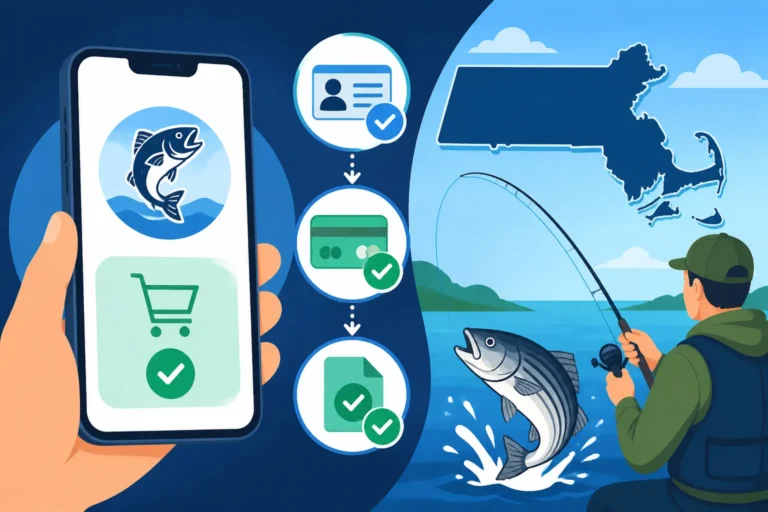
Creating or updating your account on the official portal takes just a few minutes if you follow these basic steps:
- Gather Your ID: Have your valid Massachusetts driver’s license, RMV identification card, or military/student documentation at hand.
- Access the Portal: Visit the MassFishHunt system online using a computer or mobile browser.
- Create or Claim Your Account: If you have purchased a Massachusetts license in past years, search for your existing customer profile using your ID number to avoid creating duplicate records.
- Select Your Residency Category: System options will default based on your verified RMV records. If claiming a student or military exemption, follow the prompts to select the appropriate category.
- Choose Your Permits: Select your desired freshwater license or saltwater recreational permit. If you plan on fishing unique managed waters, ensure you review specific requirements, such as What license you need to fish at Quabbin Reservoir, which may require dedicated vehicle or boat access passes in addition to your standard state license.
- Complete Payment: Pay using a valid credit or debit card, print a hard copy of your license, or save a PDF version directly to your smartphone.
Carrying Proof and Gear Rules on the Water
Having a valid license in the computer system isn’t enough; you must be able to demonstrate proof of licensure while actively fishing. Environmental police officers accept either a legible printed paper copy or a clear digital image displayed on your mobile device.
To stay completely organized on the water, consider these practical preparation tips:
- Digital Backups: Take a screenshot of your PDF license and save it to a dedicated photo album on your phone. Cell service can be spotty around remote rivers in the Berkshires or deep inside state forests.
- Physical Protection: If you prefer paper copies, store them in a heavy-duty ziplock bag or order a waterproof license holder on Amazon to clip onto your fishing vest or kayak crate.
- Valid Identification: Always carry the matching photo ID (driver’s license, military card, or student ID) that corresponds to the license number listed on your permit. Officers need to verify that the person holding the rod matches the name on the state permit.
Before heading out, double-check that your fishing tackle, line clippers, and measuring tools are packed. Ordering essential fishing accessories on Amazon before the season opens ensures you have proper measuring tapes to comply with legal fish length limits across Massachusetts waters.
Understanding the specific nuances of Carrying Proof of Your Massachusetts Fishing License keeps your days on the river or shore stress-free, letting you focus on enjoying Massachusetts’ world-class fisheries.
Disclaimer
This article is for general informational purposes only and does not constitute professional advice. Laws, prices and regulations vary by location and change over time. Consult a qualified professional for guidance on your specific situation.