Massachusetts fishing license for out-of-state college students
It can be incredibly confusing to figure out the ins and outs of fishing licenses, especially when you're an out-of-state college student living in Massachusetts. You're already navigating new classes, making friends, and trying to find your favorite local coffee shop, so adding fishing regulations to the mix can feel like a whole new level of homework. This guide is here to untangle the knot of residency rules and help you understand exactly what kind of Massachusetts fishing license you need, ensuring you stay on the right side of the law while enjoying the Commonwealth's amazing fishing opportunities.
Understanding Residency for Massachusetts Fishing Licenses
One of the biggest hurdles for out-of-state college students is figuring out if they count as a "resident" for fishing license purposes. It’s not as straightforward as just living here for school. MassWildlife, the state agency overseeing fish and wildlife, has specific criteria, and they don't always align with how the university might define your residency for tuition or housing. Getting this wrong can mean you end up paying more than you should or, worse, fishing without a proper license.
The Core Definition of a Massachusetts Resident
For fishing license purposes, MassWildlife generally defines a Massachusetts resident as someone who has resided in Massachusetts for at least six consecutive months immediately prior to applying for a license. This isn't just about having a local address; it's about establishing a genuine, primary domicile here. They're looking for signs that Massachusetts is truly your home base, not just a temporary stop. This definition applies broadly to all aspects of the Massachusetts Fishing License Guide, not just students.
This definition goes deeper than simply renting an apartment. MassWildlife often looks for multiple indicators of residency. For instance, do you have a Massachusetts driver's license? Are you registered to vote in Massachusetts? Do you file state income taxes here? While a college ID and a local dorm address are valid for campus life, they don't automatically make you a "resident" in the eyes of state wildlife regulations. It's this combination of factors that can make it tricky for students who often maintain strong ties to their home states.
Why College Students Often Face a Gray Area
The "gray area" for out-of-state college students stems from the fact that many still consider their parents' home state their permanent residence. They might keep their out-of-state driver's license, are registered to vote elsewhere, and return home for extended breaks. Even if you've been living in a dorm or off-campus apartment in Boston, Worcester, or Amherst for several semesters, if your primary legal ties are still in, say, New York or Connecticut, MassWildlife will likely consider you a nonresident.
This can be frustrating because you're living here, contributing to the local economy, and want to participate in local activities like fishing. However, the system is designed to differentiate between temporary presence and established residency to ensure that those who are permanent residents, and thus contribute to state taxes and other long-term community benefits, receive the resident rates. It's a system that aims for fairness but can feel unfair when you're caught in the middle.
Key Factors MassWildlife Considers
When you apply for a Massachusetts fishing license, especially if you're trying to claim residency as an out-of-state student, MassWildlife might consider several key factors. They want to see consistent evidence that Massachusetts is your true home. It’s not about any single document, but the overall picture your documentation paints.
Here’s a table outlining common documents and how they generally relate to proving residency:
| Document Type | Usually Accepted as Proof for MA Residency? | Notes |
|---|---|---|
| Massachusetts Driver's License | Yes | Strong indicator, especially if held for 6+ months. |
| Massachusetts State ID Card | Yes | Similar to a driver's license in proving local ID. |
| Voter Registration Card | Yes | If registered in Massachusetts. Shows intent to reside here. |
| Massachusetts Vehicle Registration | Yes | If your car is registered in MA, it's another good sign. |
| Lease Agreement (6+ months) | Sometimes | A long-term lease in your name for an apartment (not just a dorm) can help, but usually needs to be combined with other factors. |
| Utility Bills in Your Name | Sometimes | Bills for a non-dorm address (electric, gas, internet) over several months can support a residency claim. |
| Massachusetts State Tax Filings | Yes | Filing resident state income taxes in Massachusetts is a very strong indicator. |
| College ID Card | No (on its own) | Proves student status, but not necessarily residency for state licensing. |
| Dorm Address Proof | No (on its own) | A dorm address is temporary and often doesn't meet the "permanent domicile" requirement without other supporting documents. |
As you can see, simply having a local dorm address or a college ID typically isn't enough on its own. You're usually expected to demonstrate a broader commitment to residing in Massachusetts, which often aligns with other legal and civic responsibilities. This is crucial when understanding Massachusetts Fishing License Requirements by Age, as residency is a primary factor regardless of your specific age.
Specific Scenarios for Out-of-State College Students
Let's break down some common situations that out-of-state college students might find themselves in and clarify whether they would typically qualify for a resident or nonresident Massachusetts fishing license. It’s all about the nuance of your living situation and legal ties.
When You Qualify as a Resident (and Save Money!)
Even if you originally came from out of state, it is absolutely possible to establish residency in Massachusetts while attending college. If you've lived here for at least six consecutive months and taken steps to establish deep roots, you could qualify for a resident license, which is significantly cheaper than a nonresident one. For instance, if you're a student at UMass Amherst and you've lived in an off-campus apartment for over a year, you've updated your driver's license to Massachusetts, registered your car here, and even voted in local elections, then you've built a strong case for residency.
Another example might be a student who started at Boston University four years ago, moved into an apartment in Allston after freshman year, and decided to make Massachusetts their long-term home. They've shifted all their official documents, pay Massachusetts state taxes, and only visit their "home" state during holidays. In such a case, you've clearly demonstrated the intent and actions consistent with being a Massachusetts resident, thereby qualifying for the lower Massachusetts Resident Fishing License Cost. This saves you money and acknowledges your contribution to the local community.
When You Definitely Need a Nonresident License
For the vast majority of out-of-state college students, a nonresident fishing license will be the appropriate choice. If you're attending Northeastern University in Boston, living in a dorm, and plan to return to your family home in New Jersey every summer, with your driver's license, vehicle registration, and voter registration still tied to New Jersey, then you are definitively a nonresident. Even if you've been here for three years, if your legal and civic ties remain out of state, MassWildlife will consider you a visitor for licensing purposes.
Similarly, if you're enrolled at Williams College, spending your academic year in the Berkshires but maintain your primary residence, driver's license, and all other significant legal documents in Vermont, you will need to purchase a Massachusetts Fishing License for Nonresidents. This also applies to students living in off-campus housing if they haven't taken the official steps mentioned earlier to switch their primary domicile to Massachusetts. It might feel like an extra cost, but it's essential for legal compliance and avoids any potential penalties for fishing without a license in Massachusetts.
The Role of Dorms vs. Off-Campus Housing
The type of housing you live in can play a subtle but important role in determining your residency status, although it’s not the sole factor. Living in a college dorm, for instance, is often seen as inherently temporary. Dorms are explicitly for students, and the expectation is usually that you'll move out when your studies are complete or for summer break. This temporary nature makes it harder to argue that a dorm is your "primary domicile" for state residency purposes.
Conversely, if you move into an off-campus apartment, sign your own lease, and start paying utility bills in your name, it can strengthen your claim to residency. This shows a greater degree of permanence and independence from your out-of-state family home. However, even with an off-campus apartment, you'd still need to combine this with other factors like a Massachusetts driver's license, voter registration, or filing state income taxes to truly solidify your residency claim in the eyes of MassWildlife. Without those additional steps, an off-campus apartment alone won't usually be enough to turn an out-of-state student into a resident for fishing license purposes.
How to Purchase Your Massachusetts Fishing License
Once you've figured out whether you qualify as a resident or need a nonresident license, the next step is actually acquiring it. Thankfully, Massachusetts has a streamlined system that makes the process relatively easy, whether you prefer to do it online or in person.
Online Through MassFishHunt
The easiest and most common way to get your Massachusetts fishing license is through the MassFishHunt online licensing system. This platform is run directly by MassWildlife and is accessible 24/7, which is super convenient for busy college students. You'll need to create an account if you don't already have one, providing your personal details, and then you can select the type of license you need. Make sure you choose either a freshwater or saltwater permit, or both, depending on where you plan to fish. You can find more detailed instructions by checking out how MassFishHunt Works for Buying a Massachusetts License.
When purchasing online, the system will prompt you for residency information. If you claim Massachusetts residency, be prepared that MassWildlife reserves the right to request proof. If you're an out-of-state student, you'll select the nonresident option and pay the corresponding fee. It’s quick, secure, and once purchased, you can often print a temporary license immediately or simply carry proof on your phone. This method eliminates the need to trek to a physical vendor, which is a huge plus if you’re balancing classes and study groups.
In-Person Vendor Locations
While online is popular, sometimes it’s nice to talk to a real person, especially if you have questions or just prefer a tangible paper license right away. Massachusetts fishing licenses can also be purchased in person at various authorized vendor locations across the state. These typically include many town and city clerks' offices, sporting goods stores, and bait and tackle shops. For example, if you're near Worcester, you might find a local sporting goods store that's an authorized vendor, or if you're down on Cape Cod, a bait shop will almost certainly sell them.
Buying in person is a great opportunity to also pick up some local bait or get tips on local fishing spots. The staff at these vendors are often knowledgeable anglers themselves. Just remember to bring your identification, and if you’re trying to prove residency as an out-of-state student, have any supporting documents ready. They'll process your application right there, and you'll walk out with your license in hand. For a comprehensive list of places to buy a Massachusetts fishing license in person, check the MassWildlife website.
What Documentation You'll Need
Regardless of whether you purchase your license online or in person, you'll need to have certain documentation ready. This typically includes a valid form of identification, such as a driver's license or state ID. If you're applying for a resident license, and especially if your residency status might be ambiguous as an out-of-state student, it's wise to have multiple proofs of residency available. This could include a Massachusetts driver's license, proof of voter registration in Massachusetts, or recent utility bills addressed to you in Massachusetts.
For nonresident students, a valid driver's license or state ID from your home state will suffice. You won't need to prove Massachusetts residency, as you'll be purchasing the nonresident version. Always double-check MassWildlife's official guidelines before you apply, just in case there are any updates or specific requirements for certain age groups or license types. Being prepared with the correct documents will make the entire process much smoother and faster.
Important Considerations Beyond Just Residency
Getting your license is a great first step, but there are a few other critical things out-of-state college students need to keep in mind to ensure a smooth and legal fishing experience in Massachusetts. It’s not just about having the right piece of paper; it’s about understanding what that paper allows you to do.
Freshwater vs. Saltwater Permits
This is a common point of confusion for many anglers, and especially for those new to Massachusetts. You see, Massachusetts separates its fishing licenses into two distinct categories: freshwater and saltwater. A freshwater license covers all inland waters, like ponds, lakes, and rivers, while a Massachusetts Saltwater Recreational Fishing Permit is required for fishing in the ocean, bays, and estuaries. Even if you're just fishing from a pier or a beach on the coast, you need that saltwater permit. Many college towns, especially those closer to the coast like Boston or New Bedford, offer both options nearby.
It's crucial to understand that one does not cover the other. If you plan to fish both types of environments, you’ll need to purchase both licenses. For instance, if you're a student at UMass Dartmouth and want to try your luck at the nearby freshwater ponds for bass, you'll need a freshwater license. But if you also want to go striper fishing in Buzzards Bay, you’ll need the saltwater permit. These are usually purchased concurrently through MassFishHunt, simplifying the process of getting both. This difference is fully explained in the Massachusetts Freshwater vs Saltwater License Differences article.
Understanding Massachusetts Fishing License Costs and Rules
The cost of your Massachusetts fishing license will depend heavily on your residency status. As an out-of-state college student, if you qualify as a Massachusetts resident, you'll pay the much lower resident rate. If you remain a nonresident, the cost will be higher. For example, a freshwater resident fishing license is typically around $20.00, while a nonresident annual freshwater license can be closer to $30.00. The saltwater permit also has different rates, usually free for residents but a nominal fee for nonresidents.
Beyond the cost, you'll also need to familiarize yourself with the specific rules and regulations that govern fishing in Massachusetts. This includes understanding catch limits, size restrictions, and open seasons for various species. These rules can vary significantly between freshwater and saltwater fishing, and even from one body of water to another. For example, Quabbin Reservoir Fishing Permits and Rules in Massachusetts have their own unique set of regulations that are much stricter than most other places. Always consult the official Massachusetts Recreational Fishing Rules and Bag Limits, which is often found in the fishing regulations pamphlet provided by MassWildlife.
Carrying Proof of Your Massachusetts Fishing License
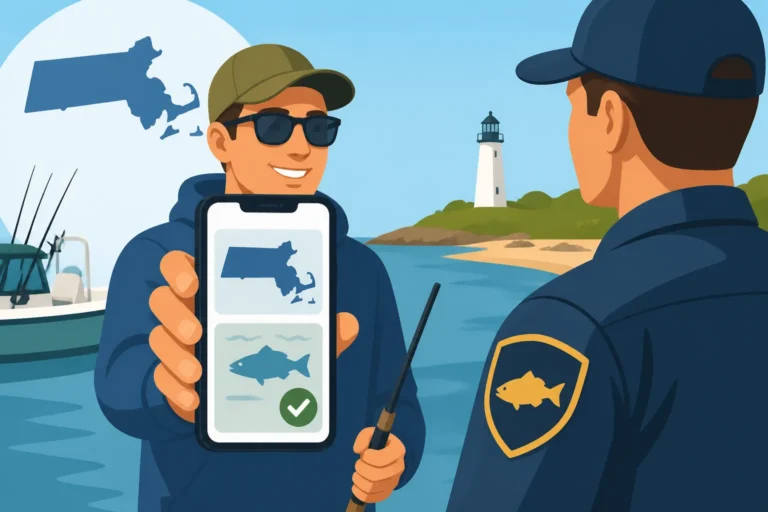
Once you’ve got your license, whether it's a resident or nonresident one, it’s absolutely vital that you carry proof of it with you whenever you are fishing. This isn't just a suggestion; it’s a legal requirement. If a Massachusetts Environmental Police Officer asks to see your license and you don't have it, you could face fines or other penalties.
Thankfully, carrying proof has become much easier. While a physical paper copy is always acceptable, MassWildlife also accepts digital proof. You can simply display a photo of your license on your smartphone or even use the MassFishHunt mobile app if you have it downloaded. Just make sure your phone is charged! It’s all about being able to readily show that you’ve legally obtained the right to fish in the Commonwealth. For more details on what counts as acceptable proof, refer to the guide on Carrying Proof of Your Massachusetts Fishing License. Don't let a simple oversight ruin an otherwise fantastic day out on the water.
Disclaimer
The information provided in this guide is for general informational purposes only and is not intended as legal advice. Fishing regulations in Massachusetts can change, and it is always the angler's responsibility to consult the most current official MassWildlife regulations before fishing.