How to troll for lake trout at Quabbin Reservoir
Trolling for lake trout at Quabbin Reservoir can feel like a formidable challenge, especially when you consider its sheer size, depth, and the unique regulations that govern it. Many anglers find themselves scratching their heads, wondering how to effectively target these elusive, deepwater dwellers amidst such vastness. This comprehensive guide aims to demystify the art of trolling for lake trout at Quabbin, providing you with the knowledge, techniques, and gear insights to turn your frustration into fishing success.
Understanding Quabbin Reservoir and Lake Trout Behavior
Before you even think about dropping a line, it's crucial to grasp what makes Quabbin Reservoir so special and how lake trout behave within its depths. This isn't your average pond; it's a magnificent, deep body of water that demands respect and a specific approach.
The Unique Challenges of Quabbin's Deep Waters
Quabbin Reservoir is one of Massachusetts's true angling gems, but it comes with its own set of challenges. It's incredibly deep in many areas, plummeting hundreds of feet, which means the fish you're after, especially lake trout, aren't always hanging out near the surface. The thermocline, that invisible layer where water temperature changes rapidly with depth, plays a huge role in where these cold-water fish will be found. In the summer months, for instance, the surface water can get quite warm, forcing lake trout to seek out cooler, oxygen-rich waters much deeper.
This depth also means light penetration is limited, affecting how fish see your lures. Understanding the contours of the reservoir floor, submerged structures, and sudden drop-offs is paramount. You can't just cast and retrieve; you need to actively present your lure at the exact depth where the lake trout are feeding. It's a game of precision, not just luck, and many a seasoned angler has been humbled by Quabbin's vastness until they learned to read its underwater landscape. Don't let the size intimidate you; let it inspire you to learn its secrets.
Lake Trout Habits and Preferred Habitats in Quabbin
Lake trout, or "lakers" as many anglers affectionately call them, are creatures of habit. They prefer cold, clear, oxygenated water, which is exactly what Quabbin provides in its deeper reaches. Unlike some other trout species that might chase insects on the surface, lake trout are often piscivorous, meaning they primarily feed on other fish like smelt, juvenile perch, and even small salmon. This dietary preference dictates the types of lures and presentations that will be most effective.
During different seasons, their preferred depths will shift significantly. In spring, when the water is uniformly cold throughout, you might find them shallower, even hitting lures in the top 20-30 feet. But as summer progresses and the surface warms, they'll retreat to the colder sanctuary of the depths, often 50 feet or more down. In the fall, as the water cools and turnover occurs, they might once again be found at various depths as they become more active, sometimes even migrating towards spawning areas. Knowing these seasonal patterns is half the battle. They also tend to hug structure—underwater humps, points, and channel edges—where baitfish congregate. Keep an eye on your sonar for these features; they're essentially lake trout magnets.
Essential Trolling Gear for Quabbin's Lake Trout
Successful trolling for lake trout at Quabbin requires specialized gear. You're not fly fishing for brook trout in a small stream here; you're often dealing with deep water, strong fish, and the need to present your lure precisely. Investing in the right tools will make all the difference.
Rods, Reels, and Lines for Deepwater Trolling
When it comes to rods, you'll want something with a moderate to fast action, around 7 to 8.5 feet in length, that can handle the stress of trolling with heavy gear or a powerful fish on the line. Fiberglass or composite rods often provide the necessary backbone and forgiveness. For reels, a good quality baitcasting reel with a line counter is almost a necessity. This allows you to accurately replicate successful depths and track how much line you have out. Think about reels designed for salmon or steelhead fishing, as they have the robust gears and drag systems needed.
Line choice is critical. While braided line offers sensitivity and strength, its lack of stretch can be a disadvantage when battling a hard-fighting lake trout. Many anglers prefer a monofilament or fluorocarbon leader to the braid for its shock-absorbing qualities and invisibility. Alternatively, if you're not using downriggers, lead core line is a fantastic option. This line has a lead center wrapped in a braided sheath, causing it to sink. Each "color" (usually 10 yards) of lead core sinks to a predictable depth at a given trolling speed, allowing you to hit those deeper zones without additional weights, though you might still add some inline weight. You can find a wide range of these specialized lines and reels on Amazon, making it easy to outfit yourself properly.
Lures, Baits, and Attractors for Lake Trout
Lake trout are primarily piscivorous, so your lure selection should reflect that. Spoons are incredibly popular and effective, mimicking injured baitfish. Brands like Sutton Spoons, Mooselook, or even larger trolling spoons designed for salmon can be deadly. Colors often depend on water clarity and light conditions; silver, blue, green, and chartreuse are perennial favorites. Stickbaits and crankbaits that dive to moderate depths or can be trolled with lead core or downriggers also work well, especially those resembling smelt.
Don't discount natural bait either. Smelt, shiners, or even strips of cut bait trolled behind a dodger or flasher can be incredibly enticing. Dodgers and flashers aren't lures themselves but are designed to attract fish by creating vibrations and light reflections, drawing lake trout closer to your actual bait or lure. The key is to match the hatch – identify what the lake trout are feeding on at Quabbin and select lures that mimic those prey items in size, shape, and color. Ordering tackle from Amazon often provides a broader selection than local shops, allowing you to experiment with different patterns and sizes.
The Importance of Downriggers and Lead Core Line
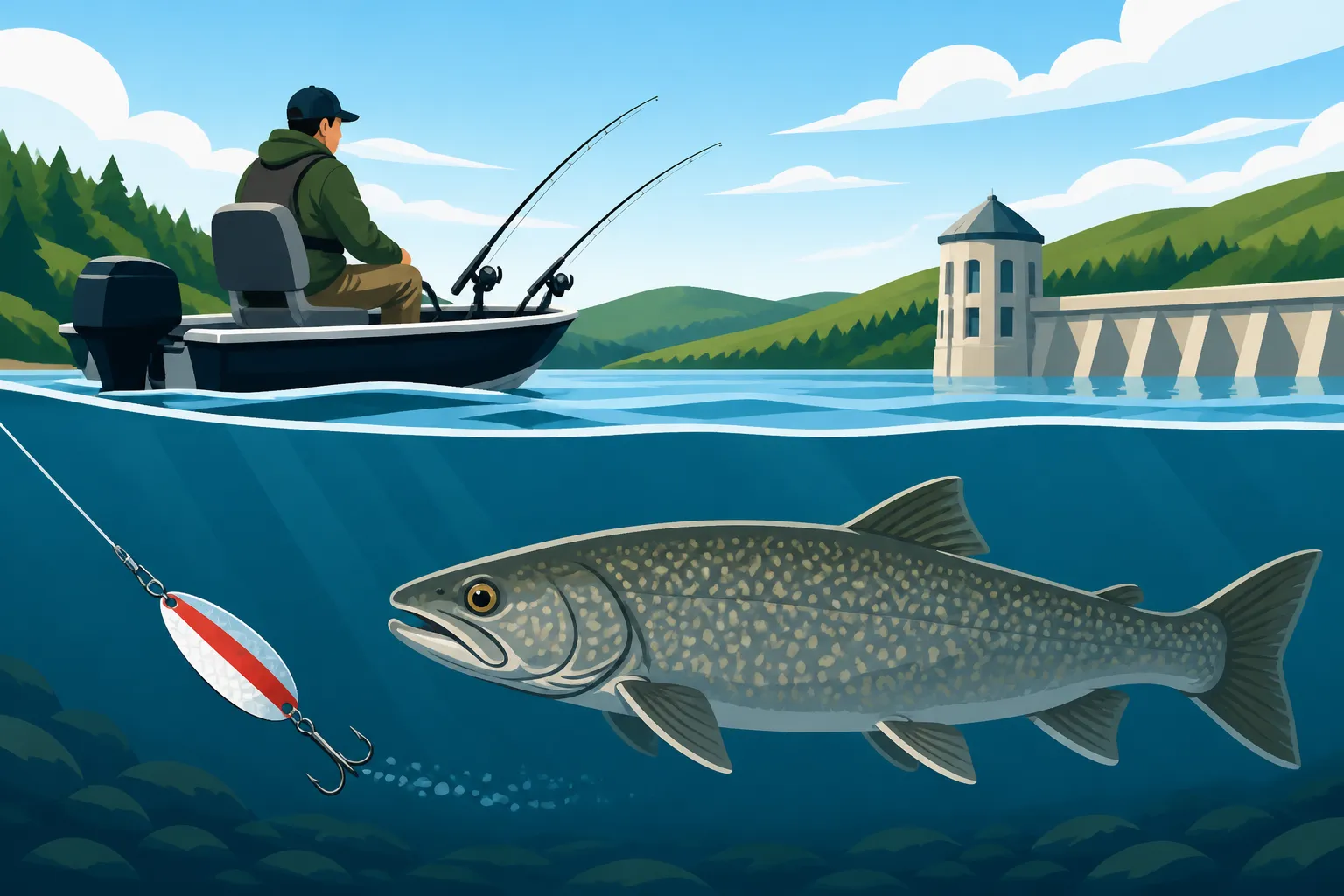
To consistently get your lures down to where the lake trout live, especially in Quabbin's deep water, you'll need specialized depth control methods. Downriggers are arguably the most precise. These devices use a heavy cannonball weight to carry your fishing line down to a set depth. A release clip holds your line to the cannonball cable, and when a fish strikes, the line pops free, allowing you to fight the fish directly without the weight. This is fantastic for targeting specific depth bands, particularly when fish are suspended.
Lead core line offers another excellent method for depth control without the bulk of downriggers. As mentioned, its inherent weight causes it to sink, and with practice, you can estimate its depth based on how many "colors" you have out and your trolling speed. A full core might take you down 50-60 feet or more. Many anglers will run a combination, using downriggers for precise deeper presentations and lead core lines for shallower, more spread-out offerings. Mastering both of these techniques will significantly increase your versatility and success rate in different conditions at Quabbin. Understanding your gear is as important as understanding the fish.
Mastering Trolling Techniques and Strategies
Knowing your gear is one thing, but knowing how to use it effectively is where the real magic happens. Trolling for lake trout at Quabbin is an active, dynamic process that requires constant attention to detail and a willingness to adapt.
Reading the Sonar and Locating Structure
Your fish finder, or sonar unit, is your best friend when trolling for lake trout at Quabbin. It's not just for seeing fish; it's for reading the underwater topography, identifying the thermocline, and spotting baitfish schools. Lake trout are almost always found near bait or structure. Look for sudden drop-offs, underwater humps, old river channels, and submerged timber. These are prime ambush points for lakers. Pay attention to suspended fish arches; these could be your target species.
The thermocline will often appear as a distinct band on your sonar. Once you locate it, and you see baitfish or target fish near it, that's your cue to adjust your trolling depth. Don't just motor around aimlessly; use your sonar to paint a picture of the underwater world and identify promising areas. Mark waypoints on your GPS whenever you find a productive area or catch a fish. This helps you return to those hotspots and develop a mental map of where the lake trout are likely to be. Remember, technology is a tool, but your interpretation of its data is what truly counts.
Varying Your Speed and Depth for Success
Trolling speed is a critical factor and often overlooked. Lake trout can be finicky. Sometimes they want a slow, meandering presentation, while other times a faster, more erratic retrieve will trigger a strike. A good starting point for lake trout trolling at Quabbin is typically between 1.8 to 2.5 miles per hour, but always experiment. Watch your rod tips; if your lure isn't moving with that enticing wobble or flash, adjust your speed. GPS-enabled speedometers are invaluable for maintaining consistent speeds.
As for depth, this is where downriggers and lead core shine. If you're seeing fish on your sonar at 45 feet, that's where you need your lure to be. Don't be afraid to stagger your depths if you're running multiple lines – for instance, one lure at 40 feet, another at 50, and one perhaps 60. This covers more of the water column and helps you pinpoint the fish's preferred depth on a given day. Always be prepared to adjust your depth if the fish move or if you stop getting bites. This constant adaptation is what separates successful trollers from those who come back empty-handed.
Effective Trolling Patterns and Routes
Just driving in a straight line isn't always the most effective strategy. Lake trout, like many predators, are opportunistic. Varying your boat's direction creates a dynamic action in your lures. When you turn, the lures on the inside of the turn will slow down and drop slightly, while the lures on the outside will speed up and rise. This change in speed and depth can often trigger a strike from a hesitant fish. Experiment with S-turns, figure-eights, or even sharp U-turns, especially over known structure.
Focus your trolling efforts on productive areas identified by your sonar or previous catches. Rather than covering vast distances, work smaller, high-potential areas thoroughly. If you get a bite or see a concentration of baitfish, circle back through that area, perhaps with a slightly different speed or depth. The wind can also play a significant role; sometimes trolling with or against the wind, or even across it, will produce better results. Observing and adapting to these conditions will make your trolling patterns more efficient and ultimately more successful.
Navigating Quabbin's Regulations for Trolling
Fishing at Quabbin Reservoir isn't just about technique; it's also about adherence to a very specific set of rules designed to protect this vital water source and its fishery. Ignoring these regulations can lead to serious penalties, so it's critical to be informed.
Licensing and Permit Requirements
First and foremost, you'll need a valid Massachusetts Fishing License Guide. This is non-negotiable for anyone over the age requiring one. For freshwater fishing at Quabbin, a standard freshwater license is what you'll need. You can typically purchase these online through the MassFishHunt system, which many find convenient. Keep in mind that specific rules for purchasing and carrying your license apply, so make sure you're always in compliance.
Beyond the general fishing license, Quabbin Reservoir has its own unique set of permit requirements. To fish from a private boat, you must obtain a special Quabbin Reservoir Fishing Permits and Rules in Massachusetts from the Department of Conservation and Recreation (DCR). This isn't just a formality; it ensures that all vessels entering the reservoir meet strict cleanliness standards to prevent the introduction of invasive species. Understanding What license you need to fish at Quabbin Reservoir is paramount, and these rules are often detailed in the DCR's annual guide. Always double-check current regulations before heading out, as they can sometimes change.
Specific Boat and Motor Rules for Quabbin
Quabbin Reservoir has some of the most stringent boat and motor regulations in the state, all designed to protect its role as a drinking water supply. Gasoline motors are strictly prohibited on the reservoir. You are only allowed to use electric motors. This means if you have a traditional outboard, it needs to be removed from your boat before launching at Quabbin. This can be a frustration for many, but it's a rule that ensures the pristine quality of the water.
Furthermore, there are strict cleaning protocols for all boats, canoes, and kayaks entering Quabbin. Your vessel must be thoroughly cleaned and inspected at one of the DCR's designated public boat launch areas. You'll need to obtain a DCR boat seal, indicating that your boat has passed inspection and is free of invasive plants and animals. Knowing How to get a Quabbin Reservoir boat permit involves understanding these cleaning and inspection processes. These rules are for everyone's benefit, protecting the unique ecosystem of Quabbin, so while they may seem a bit cumbersome, they are vital.
Catch and Release vs. Keeping Your Catch
Massachusetts has specific bag and size limits for various fish species, and lake trout at Quabbin are no exception. While regulations can vary, there's typically a limit on the number of lake trout you can keep per day, as well as a minimum size. It's crucial to consult the most current Massachusetts fishing regulations pamphlet, which can usually be found on the MassWildlife website or at license vendors. This document will outline the daily limits and legal sizes for lake trout, and any other species you might encounter, like salmon.
Many anglers practice catch and release, particularly for larger, older lake trout, to help preserve the fishery. If you choose to keep your catch, be sure to measure it immediately and accurately to ensure it meets the legal size requirements. Having a measuring board or tape easily accessible on your boat is a must. Remember, violating these limits can lead to fines and other penalties, so always fish responsibly and within the law. The health of Quabbin's fishery depends on all of us doing our part.
Quabbin Reservoir Lake Trout Trolling Depth Guide (Approximate)
| Season | Water Temperature (Surface) | Typical Lake Trout Depth (Feet) | Common Lures/Baits | Special Considerations |
|---|---|---|---|---|
| Spring | 40-55°F | 15-40 | Spoons, Smelt, Stickbaits | Often shallower after ice-out, near spawning areas. |
| Summer | 65-75°F | 40-80+ | Spoons, Live Bait, Crankbaits | Retreat to cooler, deeper waters below thermocline. |
| Fall | 55-45°F | 20-60 | Spoons, Large Minnow Imitations | More active, can be found at various depths during turnover. |
| Winter | 32-40°F (Under Ice) | 10-40 | Jigging Spoons, Live Bait (ice fishing) | Generally shallower than summer, but still deep relative to other species. |
Note: These depths are approximate and can vary significantly based on specific water conditions, weather, and baitfish location.
Essential Safety and Preparation for Quabbin Reservoir
Fishing on a large body of water like Quabbin Reservoir demands more than just angling skills; it requires thorough preparation and a strong commitment to safety. This reservoir is not to be underestimated, and being well-prepared ensures a much more enjoyable and secure experience for everyone aboard.
Checking Weather and Water Conditions
Before you even leave your driveway, you need to check the weather forecast specifically for the Quabbin area. Sudden changes in weather, especially strong winds, can turn calm waters into a dangerous chop very quickly. Quabbin's vast, open expanses offer little protection from the elements, and small boats can be easily overwhelmed. Always look for wind warnings, thunderstorm advisories, and sudden temperature drops. A sunny morning can quickly become a white-capped nightmare.
It's also a good idea to understand the water conditions. While not always readily available for anglers, knowing recent rain patterns can affect water clarity or levels, which in turn can influence fish behavior. If the forecast looks questionable, it’s always better to err on the side of caution and postpone your trip. No fish is worth risking your safety. Trust me, I've been caught out there in unexpected squalls, and it's not fun.
Required Safety Gear on Your Boat
Massachusetts boating regulations, combined with common sense for a large reservoir, mandate specific safety gear. You absolutely need a Coast Guard-approved personal flotation device (PFD) for every person on board, and children must often wear them at all times. Consider having a throw cushion or ring buoy too. Beyond PFDs, a sound-producing device like a horn or whistle is required, as are visual distress signals (flares for night fishing, a flag for daytime).
A fully charged cellular phone is crucial for emergencies, but be aware that cell service can be spotty in some remote areas of Quabbin. It’s always wise to also have a fully charged, handheld marine VHF radio as a backup. Don't forget a first-aid kit, a paddle or oars (even if you have an electric motor), and an anchor with sufficient rode. These items aren't just legal requirements; they are potentially life-saving tools that every responsible boater should have on board.
Respecting Quabbin's Natural Beauty and Rules
Quabbin Reservoir is not just a fishing destination; it's a vital drinking water supply for millions and a sanctuary for wildlife. It's imperative that all anglers treat it with the utmost respect. This means packing out everything you pack in—absolutely no litter, including fishing line, bait containers, or food wrappers. Leave no trace.
Beyond waste, be mindful of wildlife. Observe from a distance and do not disturb nesting birds or other animals. Adhere to all no-wake zones and restricted areas, which are clearly marked. These rules are in place to protect both the natural environment and the water quality. Familiarize yourself with the Quabbin Reservoir Fishing Guide for Massachusetts Anglers and adhere to all DCR guidelines. Your actions contribute to the preservation of this incredible resource for future generations of anglers and all who rely on its clean water.
Final Thoughts on Your Quabbin Lake Trout Adventure
Trolling for lake trout at Quabbin Reservoir is an incredibly rewarding experience that blends skill, patience, and a deep appreciation for nature. It's not always easy, but the moments of triumph, like seeing that rod double over from a powerful laker in the deep, clear waters, are truly unforgettable. With the right preparation, a solid understanding of the techniques, and respect for the reservoir's unique rules, you'll be well on your way to success.
Remember that fishing is a continuous learning process. Every trip to Quabbin will teach you something new about its waters, its fish, and your own angling abilities. Don't get discouraged by slow days; instead, use them as opportunities to observe, experiment, and refine your approach. Whether you're targeting the depths near the Quabbin Reservoir's William E. Pula Fishing Area or exploring new territories after getting your Massachusetts Freshwater Fishing License Costs and Rules in order, the adventure is truly in the journey. So, gear up, stay safe, and enjoy the pursuit of those magnificent Quabbin lake trout!
Disclaimer
This article is for general informational purposes only and does not constitute professional advice. Laws, prices and regulations vary by location and change over time. Consult a qualified professional for guidance on your specific situation.