Where a Massachusetts fishing license is valid across state waters
It can be incredibly confusing to figure out exactly where your Massachusetts fishing license allows you to cast a line. You’ve gone through the process of getting your permit, paid your fees, and now you’re wondering if it’s truly valid everywhere from the smallest local pond to the vast expanse of the Atlantic. This guide is here to untangle that uncertainty, explaining precisely where your Massachusetts fishing license is valid, where it isn't, and what special considerations you need to keep in mind.
Understanding Massachusetts Fishing License Basics
When you first get into fishing in the Bay State, one of the biggest initial hurdles is understanding the difference between freshwater and saltwater regulations. It's not just a matter of what fish you're targeting; it dictates the type of license or permit you need and, by extension, where it's actually valid. Many anglers assume one license covers everything, but that's simply not the case in Massachusetts.
Freshwater Versus Saltwater Licenses
In Massachusetts, we operate under a two-tiered system for recreational fishing licenses, and this is absolutely critical for understanding where you can legally fish. You'll need a Freshwater Fishing License if you plan to fish in any inland body of water—think ponds, lakes, rivers, and streams that aren't tidally influenced. These licenses are managed by the Massachusetts Division of Fisheries and Wildlife (MassWildlife). On the other hand, if your angling adventures take you to the coast, the ocean, or any tidal estuaries, you'll need a Massachusetts Saltwater Recreational Fishing Permit. This permit is regulated by the Massachusetts Division of Marine Fisheries (MassDMF). The two are distinct, and one does not typically cover the other, although there is a combined option available if you plan to do both.
The reason for this distinction goes back to how our natural resources are managed and funded. Different agencies oversee freshwater and saltwater ecosystems, each with their own conservation goals, stocking programs, and enforcement responsibilities. So, while it might seem like an extra hoop to jump through, it ensures that the specific habitats and fish species in each environment are properly looked after. It's not uncommon for an angler to hold both permits, especially if they enjoy the diverse fishing opportunities Massachusetts has to offer, from chasing trout in a mountain stream to targeting striped bass along the coast. For a more detailed look at the costs and rules, you can check out the guide on Massachusetts Freshwater Fishing License Costs and Rules.
Statewide Freshwater Coverage
Once you've secured your Massachusetts Freshwater Fishing License, you're generally good to go for almost all public inland waters within the state's borders. This means countless lakes, ponds, rivers, and streams, from the Berkshires all the way to Cape Cod, are open to you. Whether you're casting for largemouth bass in Lake Quinsigamond, fly fishing for trout in the Deerfield River, or chasing panfish in a small town pond, your single freshwater license covers these activities. The beauty of it is that you don't need a separate license for each individual body of water; it's a blanket permit for the state's entire freshwater system.
However, "statewide" doesn't mean "everywhere without exception." There are a few very notable exceptions and special regulations for specific, heavily managed freshwater bodies, which we'll dive into a bit later. But for the vast majority of our publicly accessible lakes and rivers, your standard MA freshwater license is exactly what you need. This makes planning a fishing trip across different regions of Massachusetts much simpler, as you only need to worry about local regulations for specific species or gear, not whether your license itself is valid for that particular pond. If you're wondering about specific age requirements for these licenses, take a look at our guide on Massachusetts Fishing License Requirements by Age.
Navigating Saltwater Boundaries
Stepping into the saltwater world of Massachusetts fishing brings its own set of rules regarding where your permit is valid. The ocean can feel boundless, but legally, it's divided into distinct zones, and your Massachusetts Saltwater Recreational Fishing Permit covers only a portion of it. It's crucial to understand these distinctions, especially if you're venturing offshore.
Massachusetts Coastal Waters
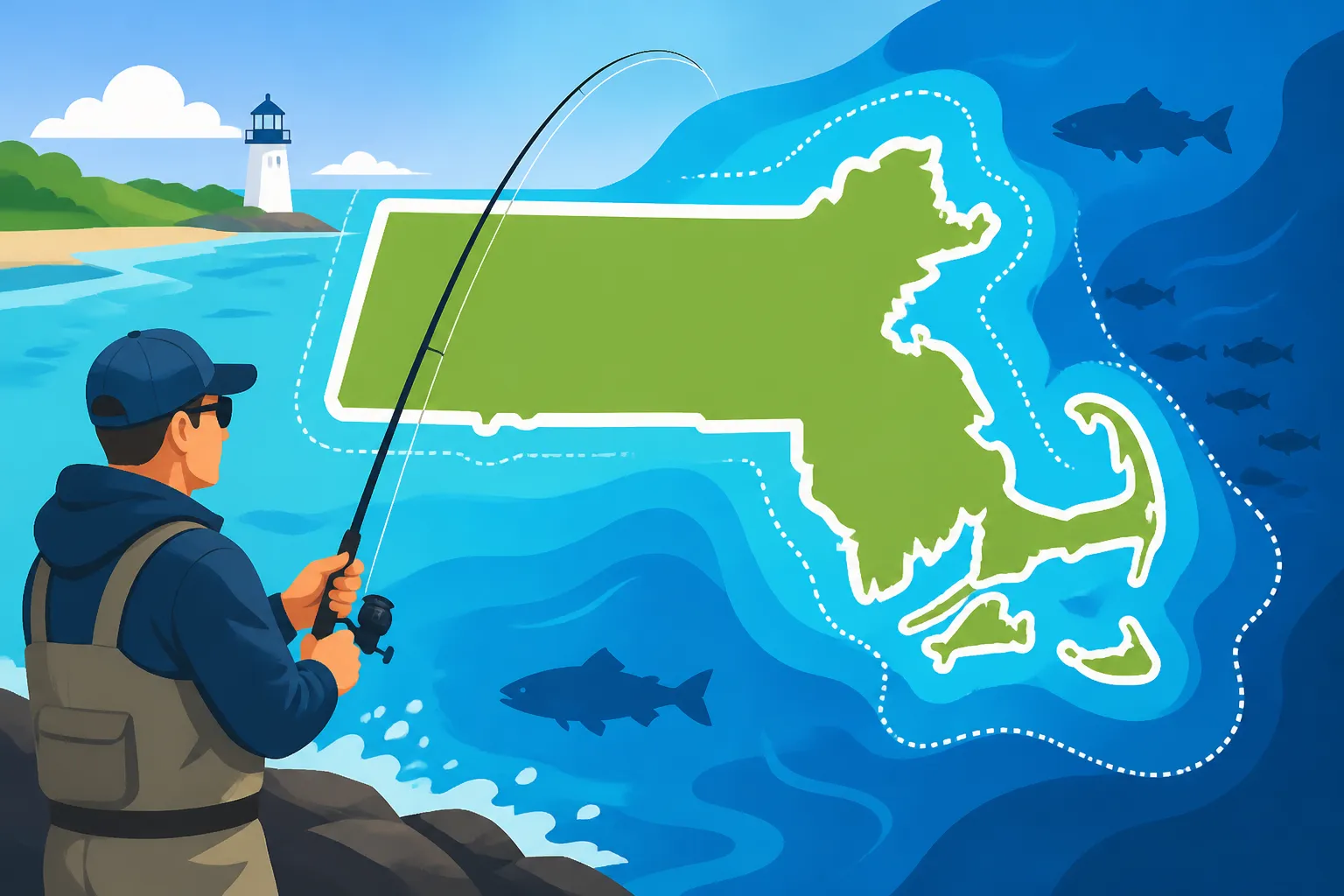
Your Massachusetts Saltwater Recreational Fishing Permit is valid for all recreational fishing activities within the state's marine waters. This generally means from the shoreline out to three nautical miles offshore. This zone encompasses everything from surfcasting on the beaches of Cape Cod and Plum Island to fishing from piers, bridges, and private boats in harbors, bays, and sounds like Boston Harbor, Buzzards Bay, and Nantucket Sound. If you're jigging for striped bass in the Cape Cod Canal, bottom fishing for tautog in coastal reefs, or seeking out bluefish in Ipswich Bay, your state saltwater permit has you covered. Essentially, if you can see land (or at least know you're not too far from it), your Massachusetts permit is typically sufficient for these nearshore and inshore areas.
It's important to remember that even within these state waters, specific regulations for species, size limits, and bag limits apply. These are set by the Massachusetts Division of Marine Fisheries and can change, so always check the latest regulations before you head out. These rules apply whether you're fishing from a boat, kayak, or shore. If you're an experienced angler looking for the best spots to catch striped bass from the surf, our guide on How to Catch Striped Bass From the Surf in Massachusetts can provide some excellent tips.
Federal Waters and Highly Migratory Species
Here's where things get a bit more complex. Beyond three nautical miles from shore, you enter what are known as federal waters. While your Massachusetts Saltwater Recreational Fishing Permit is still generally required as a baseline if you're launching from or landing in Massachusetts, it's often not the only permit you'll need, especially if you're targeting certain species. For highly migratory species like bluefin tuna, sharks, or swordfish, federal permits are typically required in addition to your state permit, even if you're operating out of a Massachusetts port. These federal permits are issued by the National Oceanic and Atmospheric Administration (NOAA) Fisheries, specifically through their Highly Migratory Species (HMS) Angling Permit program.
This means if you're planning a thrilling offshore trip to chase giants like bluefin tuna, your Massachusetts saltwater permit is just the first step. You'll also need to ensure that you or the vessel you're on possesses the correct federal HMS permit. These permits come with their own set of stringent regulations, reporting requirements, and seasons, all designed to manage these valuable migratory fish stocks across a much broader geographic range than just Massachusetts's state waters. Failure to have the proper federal permits can lead to significant fines and penalties, even if you're otherwise compliant with state law. It's a critical distinction for any angler venturing into the deep blue. For an in-depth understanding of the state-level permit, check out Massachusetts Saltwater Recreational Fishing Permit Explained.
Reciprocity with Neighboring States: A Common Misconception
This is a question that comes up all the time, and unfortunately, the answer is usually not what anglers hope for. Many people travel between states to fish and naturally assume their license from one state might be valid in another, especially in border areas. However, when it comes to Massachusetts and its neighbors, that assumption can lead to a costly mistake.
The General Rule: No Reciprocity
Let's be very clear: generally, a Massachusetts fishing license or saltwater permit is not valid in the waters of neighboring states like Rhode Island, Connecticut, New Hampshire, or New York. Conversely, a fishing license from one of those states is not valid in Massachusetts waters. Each state has its own licensing system, its own regulations, and its own conservation programs funded by those license sales. While it would certainly be convenient for anglers, blanket reciprocity simply doesn't exist for most fishing licenses across state lines in New England.
This means if you're planning a fishing trip to Narragansett Bay in Rhode Island, even if you just fished in Buzzards Bay yesterday with your Massachusetts permit, you'll need to purchase a Rhode Island fishing license to legally fish there. The same applies if you're heading to the Connecticut River but plan to fish on the Connecticut side; your MA freshwater license won't cut it. This can be frustrating, especially if you live close to a state border or enjoy fishing in multiple regions. Always plan ahead and secure the appropriate license for the state whose waters you intend to fish. Our guide on Massachusetts Fishing License for Nonresidents covers what you need if you're coming from out of state.
Border Water Considerations
While general reciprocity is rare, there can be very specific, limited agreements for waters that directly border two states. These are usually for particular rivers or lakes that physically sit on a state line. For example, specific sections of the Connecticut River that form the border between Massachusetts and New Hampshire might have special agreements, but these are exceptions to the rule and are often very narrowly defined. For most of the Connecticut River that flows through Massachusetts, your MA freshwater license is required. If you cross into New Hampshire or Connecticut waters, you'd need their respective licenses.
It's absolutely essential to consult the official regulations of both MassWildlife and the wildlife agencies of any bordering state if you plan to fish a border water. These agreements are not universal and can be subject to change. For instance, while some states might have agreements for certain lakes, it's far less common for large rivers or ocean boundaries. The safest bet is always to obtain the license for the state whose water you are actively fishing in, even if it feels like you're only a stone's throw from home. Fishing the Connecticut River in Massachusetts is a fantastic experience, but make sure you have the right credentials; our Connecticut River Fishing in Massachusetts guide has more details.
Important Exceptions and Special Permits
While your standard Massachusetts fishing licenses cover a vast range of angling opportunities, there are a handful of very specific situations where additional permits or rules apply. Ignoring these exceptions could land you in trouble, so it's always best to be informed.
Quabbin and Wachusett Reservoirs
These two massive reservoirs are jewels in Massachusetts's crown, offering incredible fishing for a variety of species, including landlocked salmon and lake trout. However, due to their primary function as drinking water supplies for metropolitan Boston, they come with a unique set of regulations that go above and beyond your standard Massachusetts Freshwater Fishing License. While you do need a valid MA freshwater license to fish these waters, you will also need a special permit specific to each reservoir.
For the Quabbin Reservoir, you'll need a special Quabbin Reservoir Fishing Permit, which often has its own set of rules regarding boat access, launch points, and even allowed gear. Similarly, Wachusett Reservoir has specific access points and regulations. These permits help manage visitor access, protect water quality, and ensure the unique ecology of these vital areas is preserved. Don't show up with just your standard freshwater license and expect to cast away; always check the specific requirements for Quabbin Reservoir Fishing Permits and Rules in Massachusetts or Wachusett Reservoir Fishing Access Rules in Massachusetts before you go.
Private Ponds and Property
Another area of common confusion revolves around fishing on private property. The general rule in Massachusetts is that if you are fishing on private land, you still need a Massachusetts fishing license unless the pond is completely enclosed within that private property and does not have any inlet or outlet connecting to public waters, and the fish were not stocked by the state. This means if a stream runs through your backyard, or a pond on your property is fed by a public waterway, you'll still need that license. The rationale is that fish can move freely between public and private waters, and the state's conservation efforts protect these mobile resources.
Even if a pond is truly private and disconnected, if the state has ever stocked it with fish, a license is still required. The best practice is always to assume you need a license unless you've thoroughly researched and confirmed an exemption. And, of course, when fishing on any private property, you absolutely must have the landowner's permission. Trespassing, even with a valid fishing license, is illegal and disrespectful.
For-Hire Vessels and Charters
Thinking about booking a thrilling deep-sea fishing trip or a guided striped bass excursion? This is another scenario where license requirements can differ. If you're fishing on a "for-hire" vessel, such as a licensed charter boat or a party boat (also known as a head boat), you typically do not need to possess your own individual Massachusetts Saltwater Recreational Fishing Permit. The vessel itself, or more accurately, the captain operating it, is generally required to hold a federal "for-hire" permit that covers all anglers on board for state and federal waters for certain species.
However, this isn't a universal exemption for all species or all trips. If you're targeting federally managed highly migratory species (like tuna or shark) on a charter, the vessel needs the appropriate federal HMS permit. It's always a good idea to confirm with your charter captain beforehand exactly what permits they hold and what species they are legally able to target, and whether you, as an individual angler, need any specific state permits. For freshwater guides, the situation is different; while the guide might have their own professional license, individual clients usually still need their personal Massachusetts Freshwater Fishing License. If you're wondering about the overall cost of these experiences, check out our guide on Massachusetts Fishing Charter Costs.
Here's a quick summary table for clarity:
| Location Type | Required MA License/Permit | Additional Permits/Notes |
|---|---|---|
| Public Freshwater | MA Freshwater Fishing License | Generally covers all public lakes, ponds, rivers, streams. |
| MA Coastal Saltwater | MA Saltwater Recreational Permit | Covers bays, sounds, inshore ocean waters out to 3 nautical miles. |
| Federal Waters (3+ mi) | MA Saltwater Recreational Permit | PLUS Federal HMS permit for highly migratory species (tuna, shark) if targeting them. |
| Quabbin Reservoir | MA Freshwater Fishing License | PLUS Quabbin Reservoir Fishing Permit. |
| Wachusett Reservoir | MA Freshwater Fishing License | PLUS Wachusett Reservoir Fishing Permit. |
| Private Ponds (Connected) | MA Freshwater Fishing License | Landowner permission also required. |
| Private Ponds (Enclosed & Not Stocked by State) | None required | Landowner permission is always required. Check status carefully. |
| For-Hire Saltwater Charter | Often covered by vessel's permit | Confirm with captain. Vessel needs federal HMS permit for tuna/shark. |
| For-Hire Freshwater Guide | MA Freshwater Fishing License | Individual angler still needs a license. Guide has professional license. |
| Neighboring State Waters | License from that state | MA license is NOT valid. Check for rare, specific border water agreements. |
Understanding these distinctions will save you headaches and ensure your fishing trips are always compliant and enjoyable. Whether you're a seasoned angler or just starting out, knowing where your Massachusetts fishing license is truly valid is a fundamental part of responsible and successful fishing. For a comprehensive look at all the regulations, you can always consult the Massachusetts Fishing Regulations Pamphlet, Explained.
Disclaimer
The information provided in this guide is intended for general informational purposes only and is subject to change. Fishing regulations in Massachusetts, including licensing requirements and specific permit rules for certain bodies of water, can be updated by state and federal agencies. It is the angler's responsibility to always consult the most current regulations published by the Massachusetts Division of Fisheries and Wildlife (MassWildlife) and the Massachusetts Division of Marine Fisheries (MassDMF), as well as any relevant federal agencies, before engaging in any fishing activity.