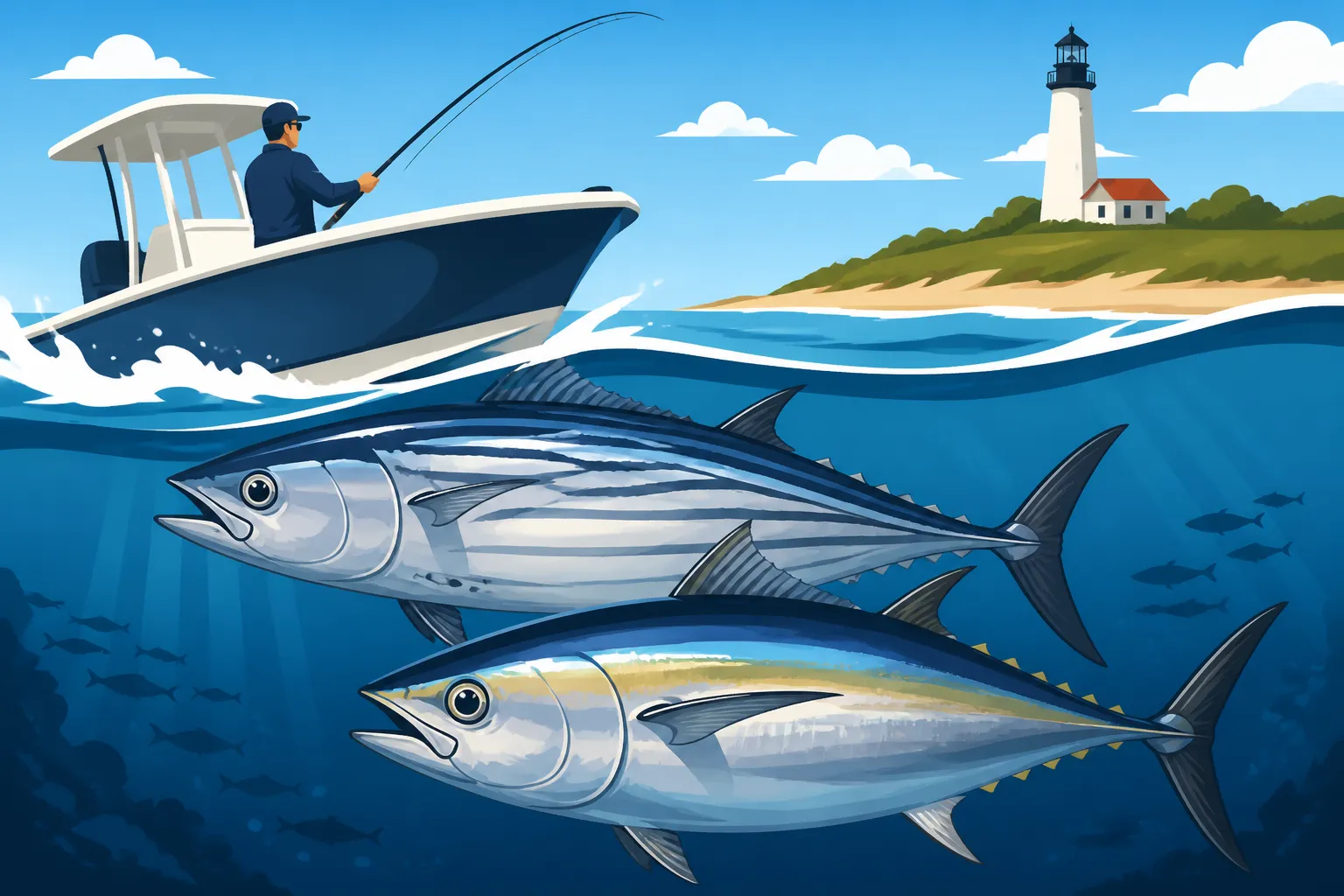
Bonito and False Albacore off Cape Cod
You've heard the whispers on the docks and seen the sudden bursts of frantic feeding offshore – those elusive, hard-fighting speedsters known as bonito and false albacore that make their annual pilgrimage to Cape Cod. Trying to figure out when and where these fish will show up, let alone what lure they'll actually strike, can be incredibly frustrating. This guide is here to unravel the mystery, offering you practical advice and insider tips to increase your chances of hooking into these exhilarating pelagic powerhouses off the Massachusetts coast.
Understanding Bonito and False Albacore: The Hard-Fighting Duo
When you mention "bonito" or "false albacore" to anglers on Cape Cod, you'll often see eyes light up with a mix of excitement and a touch of exasperation. These fish are renowned for their incredible speed and fighting prowess, making them bucket-list catches for many. However, they can also be notoriously finicky, leading to many a missed opportunity. While often grouped together due to their similar appearance and migratory patterns, they are distinct species, each with its own subtle characteristics that savvy anglers learn to identify.
Bonito: The Little Tunny's Cousin
Let's talk about the bonito first, often referred to as Atlantic Bonito. These sleek, torpedo-shaped fish are members of the Scombridae family, putting them in the same league as tunas and mackerels. They are streamlined for speed, with a pointed snout and a deeply forked tail, built to chase down fast-moving baitfish. Their coloration is striking: a dark, iridescent blue-green back that fades into silvery sides and belly. What truly sets them apart visually are the distinctive dark, diagonal stripes that run along their upper sides, extending from behind the pectoral fin towards the tail. These stripes are a key identifier, almost like nature's racing stripes.
Bonito are incredible athletes of the sea. When you hook one, be prepared for searing runs that peel line off your reel at an alarming rate. They aren't huge fish, typically ranging from a few pounds up to maybe ten pounds in our waters, but they fight well above their weight class. Many anglers consider them excellent table fare, with firm, dark meat that's delicious grilled or seared. Catching a bonito isn't just about the fight; it's about appreciating a truly magnificent game fish that provides a unique challenge and a tasty reward.
False Albacore: The "Little Tunny" Misnomer
Now, for the false albacore, or "albie" as they're affectionately known among the fishing fraternity. Despite the common nickname "little tunny," false albacore are not true tunas, though they are related. They share that same powerful, compact body plan designed for explosive speed, often making them a blur as they rocket through bait schools. Their backs are a darker, steely blue-black, graduating to a silver belly. Unlike the bonito, they lack those distinct diagonal stripes. Instead, false albacore display irregular, wavy, dark lines and spots along their sides, especially below the lateral line, towards the tail. This pattern can be a dead giveaway once you know what to look for.
The reputation of the false albacore precedes it: they are pure adrenaline on a line. When an albie hits, it's often described as like hooking a freight train. Their first run is legendary, burning drag and testing every component of your tackle. Pound for pound, many anglers consider them among the hardest fighting fish in our waters. While they're not generally considered good eating like bonito, they are pursued purely for the exhilarating sport they offer. The thrill of battling an albie, feeling that raw power, is an experience that keeps anglers coming back year after year.
Key Differences in Appearance
While both fish are silver-sided, streamlined predators, knowing the subtle visual cues can help you identify them instantly once you've landed one (or, if you're lucky, seen them clearly in the water). The most obvious differentiator is the patterning on their sides. Bonito have those neat, parallel, dark stripes running diagonally upwards and backwards from mid-body to their dorsal fin. Think of them as tiger stripes. False albacore, on the other hand, have more erratic, worm-like markings or spots below their lateral line, often extending towards the tail. These marks don't have the same organized appearance as the bonito's stripes.
Another subtle but helpful cue is the presence of teeth. Bonito have small, sharp teeth, which you'll notice if you're careful when handling them. False albacore, surprisingly, have no teeth in their mouth, feeling more like sandpaper. This makes releasing them a bit easier on your fingers! When in doubt, gently feel inside their mouth, but always be cautious with any fish. Understanding these visual and tactile differences not only helps with identification but also deepens your appreciation for these incredible species. For a broader perspective on identifying other species you might encounter, check out our Massachusetts Fish Identification Guide.
| Feature | Bonito (Atlantic Bonito) | False Albacore (Little Tunny) |
|---|---|---|
| Appearance | Sleek, torpedo-shaped body | Compact, powerful, tuna-like body |
| Back Color | Iridescent blue-green | Darker, steely blue-black |
| Side Markings | Distinct dark, diagonal stripes above lateral line | Irregular, wavy dark lines/spots below lateral line |
| Teeth | Small, sharp teeth present | No teeth (feels like sandpaper) |
| Eating Quality | Generally considered good table fare | Not typically consumed, mostly for sport |
| Fight Style | Searing, fast runs | Explosive, unrelenting, drag-screaming runs |
| Typical Size | 2-10 lbs in MA waters | 5-15 lbs in MA waters (can be larger) |
Where to Find Bonito and False Albacore: Coastal Hotspots on Cape Cod
These speed demons aren't just swimming aimlessly; they follow the bait. Understanding their migratory patterns and preferred habitats is paramount to successful fishing. Cape Cod, with its unique geography and abundance of baitfish, becomes a prime hunting ground for these pelagics as summer transitions into fall. You need to be where the action is, and that often means looking for areas that concentrate bait or offer ambush points for predators.
Coastal Hotspots: Inlets, Harbors, and Rips
On Cape Cod, several key areas consistently produce bonito and false albacore. Think about locations where water flow is strong, baitfish are abundant, and there's a good mix of shallow and deeper water. The Cape Cod Canal entrance on the Buzzards Bay side, particularly around the West End, can be a hotspot when bait pushes through. However, the Canal itself is more famous for striped bass, so keep that in mind.
Moving around the outer Cape, areas like Chatham are legendary, especially around Monomoy Island and the rips. The strong currents here create perfect feeding lanes. Further west, Buzzards Bay and its numerous harbors, like around Woods Hole and Falmouth, often see albies and bonito chasing bait in close to shore. Inlets like those around Hyannis and Cotuit can also hold fish, especially if there's a good push of bait. These fish are opportunistic, and if small baitfish like peanut bunker, silversides, or bay anchovies are abundant and pinned up against structure, bonito and albies will be there to feast. For more detailed information on specific locations around the Cape, you might want to read Best Saltwater Fishing Spots on Cape Cod, Massachusetts.
Reading the Water: Signs of Activity
Spotting bonito and false albacore on the surface is a huge advantage, as they often hunt in aggressive, visible schools. The most tell-tale sign is what anglers call "breaking fish" – baitfish erupting from the surface as predators smash into them from below. This can look like sudden splashes, a patch of nervous water, or even birds diving into the melee. Keep a sharp eye out for terns, gulls, and especially gannets, which often signal feeding activity long before you see the fish themselves. When you see birds actively diving, it's a strong indicator that bait is being pushed to the surface, and these game fish are likely involved.
Sometimes, you won't see dramatic surface busts, but rather "nervous water" – subtle disturbances on the surface that indicate a school of bait moving quickly, perhaps being harassed from below. You might also see individual fish "skipping" or "slashing" the surface as they chase bait. A good pair of polarized sunglasses is indispensable for spotting these subtle clues, allowing you to penetrate the glare and see what's happening beneath the surface. It's all about observation and being ready to cast as soon as you spot any signs of life.
Structure and Forage: What Attracts Them
Bonito and false albacore are highly migratory and pelagic, meaning they spend most of their lives in the open ocean. However, when they come closer to shore on Cape Cod, they are almost exclusively drawn by the abundance of baitfish. They follow the migration of these smaller fish into bays, harbors, and along the coastline. Look for areas where bait congregates: around structure like jetties, rocky points, oyster beds, and channel edges. These features can create current breaks or ambush points that the predatory fish exploit.
Estuaries and shallow flats can also be productive, especially during periods of high tide when baitfish might move into these areas for safety or feeding. As the tide drops, the bait gets pushed back into channels where the albies and bonito wait. Understanding these dynamics – bait movement, current, and structure – will significantly improve your chances. It's a game of connecting the dots, predicting where the forage will be, and positioning yourself accordingly.
When to Target Them: Seasons, Tides, and Conditions
Timing is absolutely everything when it comes to bonito and false albacore. These aren't year-round residents; they are seasonal visitors, and their appearance is highly dependent on water temperature and the presence of their preferred bait. You can't just go any day and expect to find them; you need to understand their patterns and capitalize on optimal conditions.
The Peak Season on Cape Cod
The prime time for bonito and false albacore on Cape Cod generally kicks off in late summer and extends through the fall. You might start seeing some early arrivals in late July, but the action really heats up in August and September. This is when the water temperatures are ideal for these warm-water migrants, and the inshore baitfish populations are at their peak. As October progresses, their numbers tend to thin out, and by late October or early November, most have moved south, following the warmer currents and bait.
Historically, the season has been fairly consistent, but year-to-year variations in water temperature and bait migrations can shift the peak weeks. Keeping an eye on local fishing reports and social media can give you real-time updates on when the fish are showing up in force. This narrow window of opportunity is part of what makes catching an albie or bonito such a prized experience – you know it won't last forever. For more on the seasonal aspects of fishing, consider exploring Massachusetts Saltwater Fishing Seasons.
Tidal Influences and Feeding Windows
Tides play a crucial role in concentrating bait and, by extension, the predatory bonito and false albacore. While they can be caught at any stage of the tide if the bait is present, many experienced anglers prefer certain phases. Often, the beginning and end of a moving tide, particularly around a tide change, can be highly productive. As the current picks up or slows down, baitfish can become disoriented or get swept out of sheltered areas, making them easy targets. Strong rips and eddies are created by moving water, and these are natural feeding stations.
Another prime window can be during the last hour or two of an outgoing tide, especially in areas with distinct channels or outflows. As the water drains from salt ponds and shallow flats, it often pushes baitfish into deeper channels where the predators lie in wait. Conversely, the incoming tide can also be good as it brings fresh, cooler water and new schools of bait into an area. The key is consistent current movement; slack tide can often be slower, but not always. Experiment with different tidal stages in your chosen spots to see what works best.
Weather and Water Temperature Considerations
Water temperature is the most critical factor for these species. They prefer warmer water, typically above 60 degrees Fahrenheit. A sudden drop in temperature, perhaps after a cold rain or a strong northerly wind, can push them out of an area quickly. Conversely, a prolonged period of warm, stable weather often means consistent fishing. Pay attention to marine forecasts and water temperature readings.
Weather conditions also influence their behavior and your ability to find them. Calm, sunny days are often ideal for spotting breaking fish on the surface. A light chop can sometimes make them less spooky and more willing to feed openly, but heavy winds and rough seas make it difficult to spot fish, cast effectively, and can even push the bait out. Overcast conditions can be excellent, as the reduced light can make fish less wary. Ultimately, a combination of warm, stable water, good bait presence, and favorable weather will give you the best shot at success. If you're wondering how certain weather patterns affect fishing generally, check out Best time to fish after a storm on Cape Cod.
Essential Gear and Tackle: Arming Yourself for the Fight
Tackling bonito and false albacore requires specific gear designed to handle their explosive power and speed. You wouldn't bring a butter knife to a sword fight, and you shouldn't bring ultralight freshwater gear to an albie encounter. While these fish aren't giants, their fight can quickly overwhelm inadequate tackle, leaving you with broken lines and shattered dreams. Investing in the right setup will not only save you frustration but also significantly increase your landing ratio.
The Right Rod and Reel Setup
For these hard-fighting speedsters, a medium to medium-heavy spinning rod in the 7-foot to 7-foot, 6-inch range is usually ideal. You want a rod with a fast action tip for casting those smaller lures a good distance, but with enough backbone to really put the hurt on a running fish. Think of something rated for 1/2 to 1 1/2 ounces of lure weight. The extra length also helps with longer casts and keeping a running fish away from obstructions.
Pair this with a high-quality, smooth-dragging spinning reel in the 3000 to 4000 size range. The drag system is paramount here. It needs to be incredibly smooth, with no stuttering or sticking, to handle those blistering runs without snapping your line. Reels from reputable brands known for their saltwater performance are a must. You can often find great deals on reliable models on Amazon or at your local tackle shop. A quality reel will make all the difference between landing that trophy and just telling a "one that got away" story.
Line and Leader Choices
Braided line is the undisputed champion for bonito and false albacore. Its thin diameter, incredible strength, and zero stretch provide maximum casting distance and sensitivity. I typically spool up with 15 to 20-pound test braided line. The thinness means less wind resistance on your cast, getting those small lures out farther, and the sensitivity allows you to feel even the most subtle taps.
Connecting your braided main line to your lure requires a fluorocarbon leader. This is crucial for two reasons: stealth and abrasion resistance. False albacore and bonito have excellent eyesight and can be very line-shy, so the near-invisibility of fluorocarbon underwater is a huge advantage. They also have rough mouths (especially bonito with those small teeth), so the abrasion resistance of fluorocarbon prevents break-offs. I recommend a 15 to 20-pound test fluorocarbon leader, typically 2 to 3 feet long. Attach it to your braid with a strong knot like an FG knot or an Albright knot, and use a small, high-quality snap swivel to connect your leader to your lure for quick changes. Remember, a cheap snap swivel can be the weakest link in your entire setup, so don't skimp here.
Lures and Baits: Favorites for "Albies" and Bonito
These fish are almost exclusively caught on artificial lures, which mimic the small baitfish they feed on. Live bait can work, but for the most part, you'll be casting. The key is "match the hatch" – present lures that resemble the size and color of the bait they are currently feeding on.
- Small Metal Jigs: These are perhaps the most popular and effective lures. Think slender, heavy jigs like the Hogy Epoxy Jig Lure, Crippled Herring, or Kastmaster. Sizes from 1/2 ounce to 1 ounce are generally effective. Colors like silver, chartreuse, olive, and pink are often deadly. These jigs cast a mile and can be retrieved quickly.
- Soft Plastics: Small soft plastics on a jig head can also be incredibly effective, especially when the fish are focused on very tiny bait. Sizes around 3-4 inches, in clear, silver, or olive colors, can entice finicky fish. The Daddy Mac line of lures offers some fantastic options in this category, and you can often find a good selection on Amazon.
- Small Topwater Plugs: Occasionally, when the fish are aggressively busting on the surface, a small topwater popper or a walk-the-dog style plug can draw explosive strikes. These are less common but can be incredibly exciting.
- Flies: For fly anglers, matching small baitfish patterns like silversides, bay anchovies, or peanut bunker imitations (e.g., Surf Candies, Clousers) will be your go-to.
The retrieve is just as important as the lure. A fast, erratic retrieve, mimicking a fleeing baitfish, is usually what triggers a strike from these high-energy predators. Experiment with speed and pauses until you find what they're reacting to on a given day. For additional lure ideas that often cross over, you might find our guide on Best Lures for Striped Bass in Massachusetts helpful.
Effective Techniques for Catching Bonito and False Albacore
Getting a strike from a bonito or false albacore is one thing; consistently hooking and landing them is another. These fish are fast, cunning, and have a knack for throwing hooks. Developing effective casting and retrieval techniques, knowing whether to fish from boat or shore, and practicing proper handling are all critical for success.
Casting and Retrieval Strategies
When you spot breaking fish, the first priority is to cast accurately and quickly. These fish move fast, and the feeding window can be incredibly short. Aim your cast beyond the school and retrieve your lure through the edges of the activity. Casting directly into the middle can sometimes spook the school. The retrieve itself is paramount: a blazing fast, erratic retrieve is almost always the ticket. Think of a dying baitfish trying desperately to escape. Vary your retrieve speed, add quick jerks and pauses, or "burn and kill" to trigger a reactionary strike.
Don't be afraid to experiment. Sometimes a steady, incredibly fast retrieve works best. Other times, a twitch-twitch-pause action is more effective. If the fish are busting far out, having gear that allows for maximum casting distance is a game-changer. Once hooked, keep the rod tip up and maintain constant pressure. Do not let these fish get any slack line, even for a second, or they will throw the hook. Their head shakes are powerful, and their speed can create slack in an instant.
Boat vs. Shore Fishing Tactics
Both boat and shore anglers can have incredible success with bonito and false albacore on Cape Cod, each with its own advantages and challenges.
Boat Fishing:
From a boat, you have the advantage of mobility. You can quickly get to breaking schools, follow them as they move, and cover a lot more water. This is particularly effective when the fish are busting offshore or in wide-open bays. Many anglers prefer to run and gun, chasing visible signs of feeding activity. Having a good fish finder can also help locate schools that might be just below the surface. A fast boat and good communication among the crew can make all the difference in getting to the action before it disappears.
Shore Fishing:
Shore fishing for albies and bonito is a thrilling challenge and often requires a different approach. Look for jetties, rocky points, and beaches that offer deep water access or are adjacent to channels where bait gets concentrated. You'll rely heavily on long casts and keen observation skills, scanning the horizon for any signs of breaking fish. Many shore anglers will move along the shoreline, trying different spots, or patiently wait for a school to come within casting range. Where to catch false albacore near Cape Cod or Best spots for bonito and false albacore off the Cape can offer more specific shore-based locations. The challenge of connecting with a fast-moving school from a stationary position makes a successful shore catch incredibly rewarding. If you're into kayak fishing, you might also find success by paddling out to schools. Our guide on Best kayak fishing spots on Cape Cod has some great tips that can apply.
Handling and Release Best Practices
Because bonito and false albacore are such strong fighters, proper handling and release are crucial for their survival, especially for albies, which are primarily a sportfish.
- Minimize Fight Time: Use appropriate tackle to land the fish as quickly as possible without over-stressing it. A long, drawn-out fight can exhaust the fish beyond recovery.
- Gentle Landing: If possible, land the fish with a net that has rubberized mesh to protect its slime coat and fins. Avoid dragging them onto rocks or sand if you intend to release them.
- Quick Release: Have your camera ready if you want a photo, but prioritize getting the hook out swiftly. Use de-hooking tools if the hook is deep. If the fish is difficult to de-hook, simply cut the leader as close to the hook as possible; the hook will rust out.
- Revival: For a fish that seems lethargic, hold it gently by the tail in the water, facing into the current, and move it back and forth to force water over its gills until it regains strength and swims away on its own power. Avoid dropping a fish back into the water without ensuring it's ready to swim.
Practicing these responsible angling techniques ensures that these incredible fish can continue to provide thrilling battles for years to come.
Comparing the Fight: Bonito's Searing Runs vs. False Albacore's Unrelenting Power
Both bonito and false albacore are renowned for their fighting ability, but ask any experienced angler, and they'll tell you there are distinct differences in how they battle once hooked. These differences contribute to the unique thrill each species offers and can influence how you approach the fight.
Bonito's Searing Runs
When a bonito hits your lure, be prepared for an initial burst of speed that feels like a rocket has just taken off. Their first run is often incredibly fast and long, peeling off a significant amount of line in a straight, searing dash. They are built for speed and use it to their full advantage. You'll feel the rod double over and the drag sing as they race away.
However, after that initial, powerful sprint, bonito tend to settle into a more circular fight, often staying deeper in the water column. While still strong and capable of short, renewed bursts, their fight tends to be more consistent and less erratic than an albie's. They'll pull hard, making you work for every inch, but their stamina might not match the sustained, unrelenting power of a false albacore. It's a fantastic fight, certainly not one to be underestimated, and truly a testament to their streamlined design. For more insights on the fight itself, you can compare it to Best technique for catching bonito off Cape Cod.
False Albacore's Unrelenting Power
Now, if a bonito is a rocket, a false albacore is often described as a miniature submarine with a jet engine strapped to it. Their initial run is not only blistering fast but often feels even more powerful and sustained than a bonito's. They seem to have an endless reserve of energy. What truly sets them apart is their sheer refusal to give up. Albies will make multiple, drag-screaming runs, often changing direction abruptly, and they fight hard all the way to the boat.
Many anglers find that even when an albie is seemingly close to the boat, it still has several powerful, last-ditch efforts left, making those final moments of the fight especially challenging. Their compact, muscular bodies generate immense power for their size, leading to a relentless tug-of-war. The sensation of an albie hitting your lure and instantly burning off 50 yards of line is addictive, and it's why so many anglers become obsessed with targeting these "ghosts of the fall." The sheer, raw power and unyielding spirit of the false albacore make it one of the most exciting light-tackle game fish available off Cape Cod. It's a truly unforgettable experience that cements their reputation among anglers.
The Thrill of the Double Hook-Up
While distinct in their fighting styles, both bonito and false albacore often school together, especially when actively feeding on dense baitfish. This creates the exhilarating possibility of a double hook-up. Imagine this: you've just cast your lure into a school of breaking fish, and two of these speedsters hit at once! Managing two individual fish, each fighting with its own unique intensity, at the same time is a true test of skill, patience, and tackle.
A double hook-up will push your drag, your rod, and your arms to their limits. One fish might be making a long, searing run while the other is battling deeper, circling. It requires careful rod management, quick adjustments to drag, and a bit of luck to land both. But when you do, the sense of accomplishment is immense. It's a chaotic, adrenaline-fueled dance that perfectly encapsulates the excitement of targeting these phenomenal game fish on Cape Cod. It's also a clear sign that you've hit the peak of the fall run, a season many anglers look forward to all year, perhaps even more than the When the striped bass fall run happens in Massachusetts.
Disclaimer
This article is for general informational purposes only and does not constitute professional advice. Laws, prices and regulations vary by location and change over time. Consult a qualified professional for guidance on your specific situation.