Difference between American eel and sea lamprey
There's often a moment of confusion when you pull something long and snake-like out of the water here in Massachusetts. Is it a slimy, wriggling eel, a prized baitfish for striped bass? Or is it something else entirely, perhaps a creature with a much less welcome reputation? This confusion is incredibly common among anglers, and it's vital to know the difference between the native American eel and the parasitic sea lamprey, not just for identification but for understanding their unique roles in our waterways and how you might interact with them. This guide will help you confidently tell them apart, understanding their biology, behavior, and what they mean for your fishing experience.
What are American Eels and Sea Lampreys?
Before we dive into the nitty-gritty of telling these two creatures apart, let's get a basic understanding of what each one is. They might both look like elongated, finless fish at first glance, but they hail from vastly different branches of the aquatic family tree and lead completely different lives.
The Elusive American Eel
The American eel, Anguilla rostrata, is a true fish, belonging to the order Anguilliformes. These fascinating creatures are catadromous, which means they spend most of their lives in freshwater or brackish estuaries, only to migrate to the Sargasso Sea in the Atlantic Ocean to spawn. Think about that for a second – they travel thousands of miles to a specific, deep ocean location just to reproduce! Here in Massachusetts, you can find them in nearly every river, stream, pond, and coastal estuary. They're often hidden during the day, tucked under rocks or burrowed in mud, emerging at night to hunt. Anglers sometimes target them as bait for larger game fish like striped bass, and some find them quite tasty themselves. They are a crucial part of our ecosystem, acting as both predator and prey, and playing a unique role in nutrient transfer between marine and freshwater environments.
The Ancient Sea Lamprey
Then there's the sea lamprey, Petromyzon marinus. While it might look like an eel, it's actually an ancient, jawless fish, more closely related to hagfish than to true eels. These aren't your typical finned, scaled fish. Sea lampreys are anadromous, meaning they live in saltwater as adults but migrate into freshwater rivers and streams to spawn. Their lifecycle is truly unique. After hatching, they spend several years as filter-feeding larvae called ammocoetes, burrowed in stream bottoms. Once they transform into adults, they become parasitic, attaching themselves to other fish (and sometimes marine mammals) with their suction-cup mouth and rasping tongues, feeding on blood and bodily fluids. While they are native to the Atlantic Ocean and some of its tributaries, including Massachusetts, they are often considered invasive in the Great Lakes, where they have caused significant ecological damage. Their presence in our coastal rivers is a natural part of the ecosystem, but encountering one can be quite startling if you're not expecting it.
Key Physical Differences: How to Tell Them Apart
This is where the rubber meets the road. When you're standing by the water's edge, or if you've got one on the end of your line, how do you quickly and accurately identify if it's an American eel or a sea lamprey? The distinctions are clear once you know what to look for.
Mouth Structure: The Most Obvious Clue
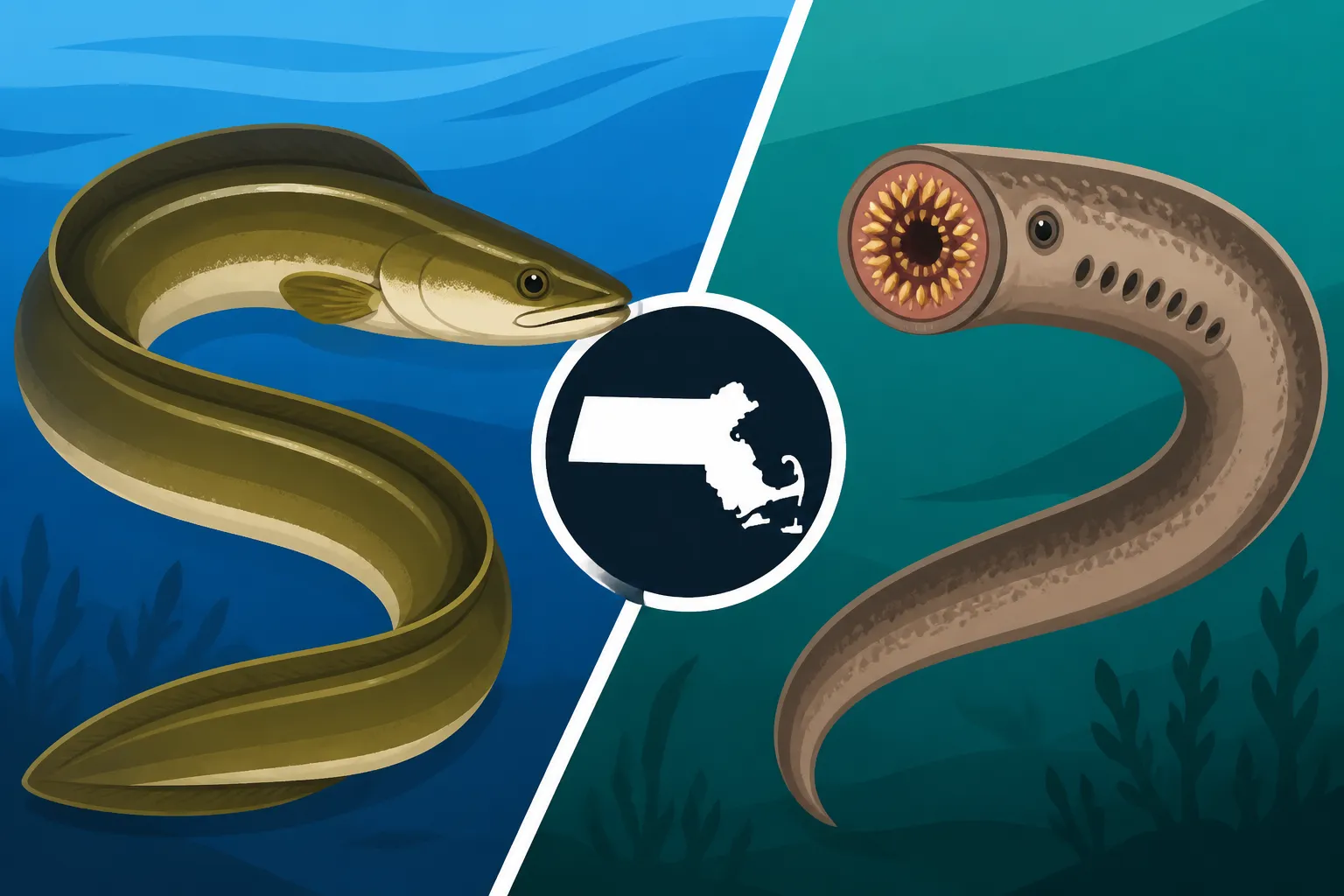
This is, without a doubt, the single most telling difference. An American eel has a distinct, fully functional jaw with small, conical teeth. Its mouth opens and closes like a typical fish, and you can clearly see the upper and lower jaws. If you were to look closely, you'd see a small, pointed snout. It uses this mouth to snatch small fish, insects, and crustaceans.
The sea lamprey, on the other hand, possesses a circular, sucker-like mouth that is almost always open. This mouth is lined with rows of sharp, horny teeth, and often has a rasping tongue-like structure in the center. It has no jaws in the traditional sense. This unique mouth is perfectly adapted for its parasitic lifestyle, allowing it to latch onto its host. If you see something that looks like a gaping, toothy suction cup, you're looking at a sea lamprey. This feature alone is usually enough for a positive identification.
Fin Arrangement and Body Shape
While both are elongated, there are subtle differences in their fins and overall body structure. The American eel has pectoral fins located right behind its head, much like other fish. It also has a continuous dorsal, caudal (tail), and anal fin that runs almost the entire length of its body, blending seamlessly into one another. Its body is generally more robust and muscular, especially towards the head, tapering slightly towards the tail. The skin feels smooth and very slimy due to a protective mucous layer.
A sea lamprey lacks pectoral and pelvic fins entirely. Instead, it has two distinct dorsal fins on its back, separated by a gap, and a smaller caudal fin. These fins are often low and somewhat fleshy. Its body is typically more uniformly cylindrical and snake-like, without the noticeable taper of an eel's head-to-tail. The skin is also smooth but lacks the prominent slime of an eel, though it can still be slippery. If you're looking for pectoral fins, and can't find any, that's a strong indicator of a lamprey. This is also a good point of reference if you are trying to understand the Difference between American eel and sea lamprey.
Skin and Coloration
While coloration can vary based on habitat and life stage, there are general patterns to observe. American eels typically have a dark, often olive-green or brownish back, fading to a lighter, yellowish or white belly. They are very camouflaged against river bottoms and vegetation. Their skin is incredibly smooth and, as mentioned, quite slimy, which helps them navigate tight spaces and protects them from abrasions.
Sea lampreys, especially adult migratory ones, tend to be mottled grey, brown, or black on their backs, with lighter undersides. They often have irregular dark blotches or patterns. Their skin is smooth, but it lacks the thick, protective slime coat of an eel. The texture feels less robust, almost more cartilaginous to the touch, which makes sense given their primitive skeletal structure. When you're trying to figure out if you've caught a lamprey or an eel, the overall feel and color pattern can offer additional clues to supplement the crucial mouth and fin observations. Sometimes, a quick search on a device or even a reference guide, perhaps one you ordered from Amazon, can help confirm details like specific coloration patterns.
To make these differences clear, here’s a quick comparison:
| Feature | American Eel (Anguilla rostrata) | Sea Lamprey (Petromyzon marinus) |
|---|---|---|
| Mouth | Has distinct upper and lower jaws, small teeth. | Circular, sucker-like mouth with rows of horny teeth. |
| Pectoral Fins | Present, behind the head. | Absent. |
| Dorsal Fins | Continuous with caudal and anal fins, single long fin. | Two separate dorsal fins, distinct gap between them. |
| Body Shape | More robust, tapers slightly. Very slimy skin. | More uniformly cylindrical, less slimy skin. |
| Eyes | Well-developed eyes, clearly visible. | Smaller, less prominent eyes. |
| Gills | Gill slits covered by an operculum (gill cover). | Seven distinct, round gill openings in a row behind eye. |
| Lifecycle | Catadromous (fresh to salt to spawn). | Anadromous (salt to fresh to spawn). |
Behavioral and Habitat Differences
Beyond their physical traits, American eels and sea lampreys exhibit vastly different behaviors and prefer distinct habitats throughout their lives. Understanding these differences can help you anticipate which creature you might encounter in a particular body of water.
Migration Patterns and Life Cycles
The life cycle of an American eel is truly remarkable. They hatch as larvae in the Sargasso Sea, drift with ocean currents for months or even years, then transform into "glass eels" and later "elvers" before entering freshwater systems along the Atlantic coast. Once in rivers and ponds, they spend many years (sometimes over a decade) growing as "yellow eels," actively feeding and living a somewhat solitary life. When they reach sexual maturity, they transform into "silver eels," change color, their eyes enlarge, and their digestive system shuts down. They then undertake their incredible migration back to the Sargasso Sea to spawn once and die. This means you'll find them at various stages, from tiny elvers in spring runs to large yellow eels in ponds and rivers year-round. If you're looking for information on their general presence, our guide on Massachusetts Freshwater Fish Species might be helpful.
Sea lampreys also have a complex migratory pattern, but it’s essentially the inverse of the eel. They are born in freshwater rivers, where their larvae (ammocoetes) live for several years burrowed in the sediment, filter-feeding. After metamorphosis, they migrate downstream to the ocean, where they spend 1-3 years as parasitic adults, feeding on larger fish. When it's time to reproduce, they return to freshwater rivers to spawn, build nests (called redds), and then die. This anadromous pattern means you're most likely to encounter adult sea lampreys during their spawning runs in spring and early summer in coastal rivers, often making their way upstream against strong currents. Observing their migration can be fascinating, but remember their primary objective is reproduction, not interacting with anglers.
Feeding Habits and Diet
This is where their fundamental biological differences truly manifest. American eels are opportunistic predators and scavengers. They have a varied diet that includes insects, worms, small fish, crustaceans, and even carrion. They hunt primarily at night, using their keen sense of smell to locate food. They are an important part of the food web, helping to keep aquatic insect and small fish populations in check. Anglers often catch them using bait like worms, cut bait, or even small fish. If you're looking for reliable baitcasting reels or fishing line to target eels, many popular brands are readily available on Amazon.
Sea lampreys, as adults, are ectoparasites. They attach to other fish using their suction-cup mouth and use their rasping tongue to create a wound, feeding on the host's blood and body fluids. They don't actively "hunt" in the same way an eel does; rather, they latch on and feed. While their presence in the ocean is natural, a heavily parasitized fish can be weakened or even killed. The larval ammocoetes, however, are harmless filter feeders, sifting microscopic organisms from the water while buried in the stream bed. You won't typically catch an adult sea lamprey on a hook and line, as they aren't looking for bait in the traditional sense. If you were to encounter one, it would likely be by accident, or you might see them migrating or attached to other fish.
Preferred Habitats in Massachusetts
Given their different life histories and feeding strategies, American eels and sea lampreys tend to utilize different parts of Massachusetts' aquatic environments. American eels are incredibly adaptable and can be found almost anywhere there's water, from the muddy bottoms of freshwater ponds and lakes to the brackish marshes of coastal estuaries and even saltwater bays. They prefer slower-moving water with plenty of cover, like submerged logs, rocks, or dense vegetation, where they can hide during the day. Are American Eels Common in Massachusetts Rivers? Yes, absolutely, they are a widespread and vital component of these ecosystems.
Sea lampreys, particularly during their adult, spawning phase, are strictly tied to freshwater rivers and streams that connect to the ocean. They need clean, flowing water with suitable gravel or rocky bottoms to build their nests. You'll observe them during their spawning runs in spring and early summer, actively moving upstream. While they spend their adult feeding phase in the open ocean, it's their return to specific freshwater spawning grounds that makes them visible to many Massachusetts residents. The Connecticut River Fishing in Massachusetts is one such location where you might observe their migrations.
Ecological Roles and Angler Interactions
Understanding the distinction between these two creatures isn't just an academic exercise; it has real implications for anglers and the ecosystem as a whole. Both play unique, though very different, roles in the natural world.
Why Anglers Care: Fishing for Eels
For many anglers, American eels are a valuable resource. They are excellent bait, particularly for large striped bass, which are known to gorge on them. Live eels are often fished whole, or cut into chunks for chumming and bottom fishing. The resilience and hardiness of eels make them fantastic live bait, capable of withstanding rough conditions and attracting trophy fish. Anglers also sometimes fish for eels for consumption; they are considered a delicacy in some cultures. Eels are abundant in many Best Freshwater Ponds and Lakes in Massachusetts and throughout the coastal waters.
If you're specifically targeting eels for bait or consumption, there are specialized traps and methods. Setting an eel pot can be an effective way to catch them, and these often come with specific regulations. Always check local fishing regulations regarding eel harvesting before you head out. A sturdy fishing glove can be a real asset when handling these slippery creatures, and you can find a wide selection of durable fishing gloves on Amazon. They really do help with the slime!
Interactions with Sea Lampreys: A Different Experience
Your interaction with a sea lamprey will likely be much different. As mentioned, they aren't typically caught on a hook and line. If you do encounter one, it's usually either swimming upstream during a spawning migration or, more disturbingly, attached to another fish you've caught. While their parasitic nature can be unsettling, it's important to remember that sea lampreys are native to the Atlantic and have coexisted with many fish species for millennia. In these environments, fish have evolved to cope with lamprey predation, and their populations are generally in balance.
If you catch a fish with a lamprey attached, the best course of action is generally to carefully remove the lamprey and release both. Sea lampreys are not considered good for eating by most, and there are no specific bag limits or seasons for them in Massachusetts as they are not a sport fish. They are a natural part of the Massachusetts Saltwater Fish Species and freshwater spawning runs.
Conservation Status and Regulations
The American eel population has faced challenges due to habitat loss, dams blocking migration, and overfishing in some areas. As a result, regulations surrounding their harvest and sale are in place and can vary. It’s always critical to consult the most current Massachusetts fishing regulations pamphlet, which can often be found at tackle shops or online, to ensure you are compliant with any size limits, possession limits, or harvest methods for eels. Knowing these rules is part of being a responsible angler, and there's a great article on the Massachusetts Fishing Regulations Pamphlet, Explained.
Sea lampreys in Massachusetts are generally not subject to recreational fishing regulations, as they are not a targeted species for sport or consumption. Their populations in native Atlantic waters are generally stable, and they are recognized as an important part of the natural ecosystem, especially in their role transferring marine nutrients to freshwater systems through their spawning migrations. This is distinct from their invasive status and management in other regions, like the Great Lakes. Understanding the conservation nuances of both species underscores the importance of proper identification.
Disclaimer
This article is for general informational purposes only and does not constitute professional advice. Laws, prices and regulations vary by location and change over time. Consult a qualified professional for guidance on your specific situation.