How to jig for bluefin tuna near Cape Cod
The thrill of chasing bluefin tuna near Cape Cod is an unparalleled experience, but it’s also incredibly demanding, often leaving anglers feeling like they’re searching for a needle in a haystack. The sheer power of these fish, coupled with the vastness of the ocean, can make the dream of landing one seem daunting. If you've been yearning to connect with a bluefin using the dynamic and engaging method of jigging, but aren't sure where to start or how to refine your approach, you’re in the right place. This guide will walk you through everything you need to know about successfully jigging for bluefin tuna in the rich waters off Massachusetts.
Understanding Bluefin Tuna Behavior and Habitat Near Cape Cod
Bluefin tuna are apex predators, and their presence in the waters around Cape Cod isn't random. They follow food sources, and understanding these patterns is your first step to success when jigging. It’s not just about dropping a jig; it’s about putting that jig in front of a hungry tuna.
Why Bluefin Tuna Are Drawn to Cape Cod Waters
The waters surrounding Cape Cod and extending into the Gulf of Maine are a vibrant feeding ground for bluefin tuna. This area, particularly spots like Stellwagen Bank, Cape Cod Bay, and the offshore canyons, acts as a natural buffet. The rich upwelling currents bring nutrient-dense water to the surface, creating an explosion of baitfish like mackerel, herring, and sand eels. These smaller fish are the primary reason bluefin tuna migrate to these cooler, food-rich waters from late spring through fall. The availability of consistent, dense bait schools is paramount.
Beyond the sheer volume of bait, the diverse underwater topography also plays a critical role. Deep drop-offs, underwater canyons, and expansive banks provide prime hunting grounds where tuna can ambush their prey. They use these features to concentrate bait, making it easier to feed. Strong currents around features like the Cape Cod Canal Fishing Guide for Massachusetts Anglers also create feeding lanes and bring bait directly to waiting predators. Knowing these patterns helps you anticipate where the tuna might be holding, allowing you to position your boat for optimal jigging opportunities.
Water temperature is another crucial factor. Bluefin tuna prefer specific temperature ranges, and as the season progresses, they'll shift their locations to find these ideal conditions. Early season, they might be found in slightly warmer pockets, while peak season sees them spread across larger areas with consistent temperatures. These dynamic conditions mean that staying informed about water temperature charts and local fishing reports is just as important as knowing your gear.
Seasonal Patterns and Prime Time for Jigging
The bluefin tuna season off Massachusetts typically kicks off in late May or early June when the first waves of smaller "schoolie" tuna begin to arrive, following the bait. This initial push can offer some fantastic jigging opportunities, especially for those looking for a more manageable fight. As summer progresses into July and August, the tuna population swells, and larger fish, often in the 100-300 pound range, become more common. This is often considered the peak season for jigging, as the tuna are actively feeding on abundant bait.
Moving into September and October, the fishing can remain excellent, sometimes even picking up in intensity as the tuna fatten up for their migration south. This fall run is when some of the biggest tuna are caught, as they are at their heaviest and most aggressive. However, the weather can become more unpredictable during this time, so choosing your days wisely is crucial. While charter boats operate extensively during this period, if you're venturing out on your own, always prioritize safety and check marine forecasts. Many anglers often look to book a Massachusetts Bluefin Tuna Charters to ensure they are on the water during the prime times.
The "prime time" for jigging isn't just about the month, but also the time of day. Early mornings and late afternoons, often referred to as "the bite," can be particularly productive as tuna are most actively feeding. However, bluefin can feed throughout the day, especially if a large bait school is located. Paying close attention to bird activity, bait balls on your sonar, and reports from other anglers can help you pinpoint those narrow windows of intense feeding activity. When planning your trip, consider checking out the Best Month for Bluefin Tuna Charters off Massachusetts to maximize your chances.
Essential Gear for Jigging Bluefin Tuna
Jigging for bluefin tuna is not for the faint of heart, nor for light tackle. These fish are immensely powerful, and your gear needs to be up to the task. Skimping on quality here can lead to heartbreak.
Rods, Reels, and Line Selection
For bluefin jigging, you'll need a robust conventional or heavy-duty spinning setup. Your rod should be a specialized jigging rod, typically 5' to 7' long, with a fast action and incredible backbone. It needs to be able to handle immense pressure and lift heavy fish without breaking. Popular jigging rod brands include OTI, Black Hole, and Shimano, which are designed to absorb the shock of a powerful tuna while allowing you to maintain leverage. Finding the right rod can make a huge difference in the fight, so don't be afraid to invest in quality.
Reels are arguably the most critical component. For conventional setups, star drag or lever drag reels like the Shimano Talica, Penn International, or Daiwa Saltiga are favorites, capable of holding hundreds of yards of heavy braid and delivering 30-50+ pounds of smooth drag. For spinning setups, models like the Shimano Stella, Daiwa Saltiga, or Penn Slammer are top-tier choices, built with robust gears and powerful drag systems to withstand sustained battles. You can find a wide range of these high-performance rods and reels, along with specialized terminal tackle, on platforms like Amazon, often with competitive pricing and detailed reviews to help you choose.
When it comes to line, braided line is essential due to its thin diameter, incredible strength, and zero stretch, which allows for better jig action and direct hooksets. Typically, anglers will spool up with 60-100 lb test braid, depending on the size of the tuna anticipated and the rod/reel class. For leaders, a long section (10-20 feet) of 80-200 lb fluorocarbon is crucial. Fluorocarbon is nearly invisible underwater and has excellent abrasion resistance, which is vital against a tuna's rough mouth and tail. Connecting your braid to your leader with a strong knot like an FG knot or a good quality swivel and crimped connections is non-negotiable.
Types of Jigs and Rigging Strategies
The world of tuna jigs is diverse, but they generally fall into two main categories for bluefin: vertical jigs and slow-pitch jigs. Vertical jigs, often called "butterfly" jigs, are typically long, slender, and hydrodynamic, designed to flutter and dart on the retrieve. They come in various weights, from 6 oz to over 16 oz, to match water depth and current. Common colors include silver, blue/silver, pink, and glow-in-the-dark, mimicking common baitfish. Slow-pitch jigs are designed for a more subtle, fluttering, and wobbling action on the drop, resembling an injured baitfish. These are often broader and more leaf-shaped.
| Jig Type | Weight Range (oz) | Typical Action | Best For | Retrieve Style |
|---|---|---|---|---|
| Vertical/Butterfly | 6-16+ | Fast, erratic darting | Aggressive, fast-feeding tuna | Fast pumps and drops, quick retrieves |
| Slow-Pitch | 4-12+ | Slow, fluttering wobble | Finicky tuna, deeper water, slower presentations | Gentle lifts, pauses, controlled drops |
| Knife Jigs | 8-20+ | Rapid descent, tight wiggle | Strong currents, deeper water, larger tuna | Fast, aggressive rips, steady retrieve |
Rigging your jigs correctly is paramount. Most jigs will come with or be designed for assist hooks. These single, incredibly strong hooks are attached to the jig via a braided assist cord, often positioned at the top, bottom, or both ends of the jig. Assist hooks provide a better hookup ratio and prevent the jig from fouling on the line during the fight. Ensure your assist hooks are appropriately sized for the jig and are rated for heavy tackle; cheap hooks will straighten under tuna pressure. Many anglers purchase these specialized jigs and assist hook sets directly from online retailers like Amazon due to the wide selection and specific requirements for tuna fishing.
Always check the strength of your split rings and solid rings connecting your leader to your jig and assist hooks. Bluefin tuna will test every component of your tackle to its absolute limit. Using heavy-duty swivels, rated for at least double your line test, can prevent line twist, especially with fast jigging retrieves. The goal is to create a strong, clean connection that minimizes failure points.
Sonar and Electronics: Finding the Fish
In the vast expanse of the ocean, finding the fish is half the battle, and this is where high-quality sonar and electronics become indispensable. A good fishfinder, especially one with CHIRP technology, will allow you to see bait balls and individual tuna arches clearly, even at considerable depths. Brands like Furuno, Simrad, Garmin, and Raymarine offer excellent options that provide crisp, detailed images of what's beneath your boat. Understanding how to interpret your sonar screen – distinguishing between clouds of bait, individual large marks, and even the "thermocline" where fish often congregate – is a skill developed over time.
Beyond just seeing fish, your electronics help you understand the entire underwater ecosystem. You'll be looking for dense schools of baitfish, which appear as large, often dense, red or yellow blobs on your screen. Tuna will typically be found either directly under, within, or just above these bait schools. Sometimes, you'll see large, distinct arches or even groups of arches "crashing" into the bait, indicating active feeding. Side-scan or down-scan imaging can also be incredibly helpful in identifying structure and bait further away from directly beneath the boat, giving you more time to react and position your drift.
GPS and chart plotters are also critical for offshore tuna fishing. They allow you to mark productive spots, monitor your drift, and navigate safely, especially when you're many miles offshore. Knowing your exact coordinates allows you to return to areas where you've found bait or hooked fish. The ability to overlay real-time satellite imagery or bathymetric charts can further enhance your understanding of the bottom contours and potential feeding zones. Without reliable electronics, you're essentially blind fishing, severely limiting your chances of success.
Jigging Techniques for Bluefin Tuna Success
Once you have the right gear and have located potential tuna holding areas, it's time to put your jigging skills to the test. This isn't just a simple up-and-down motion; it's an art form that requires finesse, strength, and adaptability.
Vertical Jigging Basics
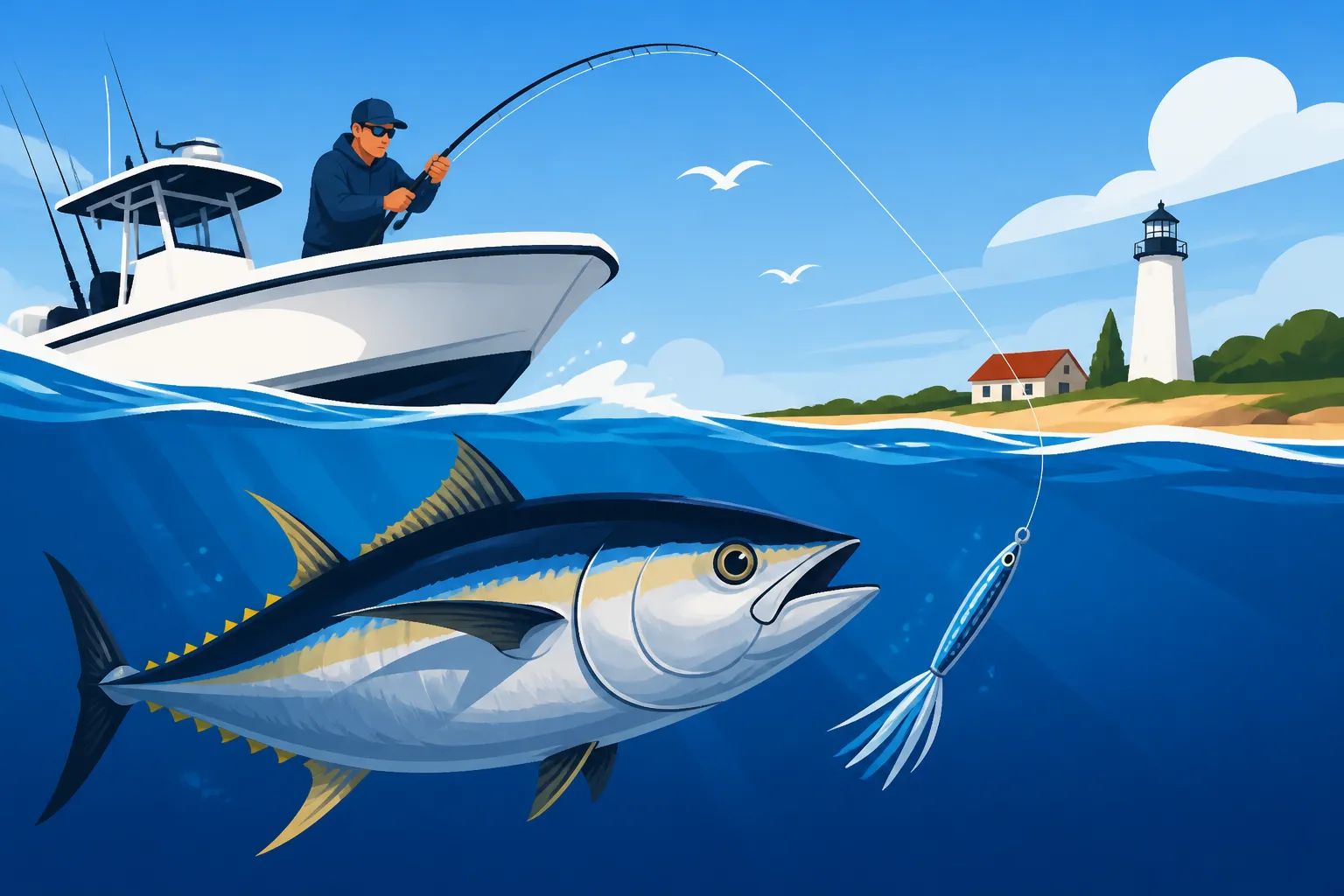
The most common method for jigging bluefin is vertical jigging. The technique generally involves dropping your jig straight down to the depth where you're seeing tuna or bait on your sonar. Once at the desired depth, you retrieve the jig using a series of aggressive "rips" or "sweeps" of the rod, followed by a quick retrieve of the reel handle, often called "speed jigging." This action makes the jig dart, flutter, and flash, mimicking a panicked baitfish. A good retrieve might involve 3-5 quick rips, reeling in the slack, and then letting the jig fall briefly before repeating.
Varying your retrieve speed and style is crucial. Sometimes, a super-fast, aggressive retrieve is what triggers a strike, especially when tuna are actively chasing bait. Other times, a slower, more deliberate retrieve with longer pauses on the drop can be more effective, particularly if the tuna are a bit lethargic or shy. The "butterfly" jigging technique, popularized by Japanese anglers, focuses on the jig's flutter on the drop, which can entice strikes from finicky fish. Pay attention to what works on a given day and don't be afraid to experiment. Keep your rod tip moving, feeling for subtle taps or changes in the jig's action, as a tuna strike can be surprisingly gentle before the rod doubles over.
Often, bluefin tuna will strike on the drop, so it's vital to maintain a "tight" line, or at least be prepared for an immediate hookset, even when the jig is falling. If you feel anything unusual—a sudden weight, a slackening of the line, or a quick thump—set the hook immediately and powerfully. Bluefin have tough mouths, and a solid hookset is necessary to properly embed the hook. For more general guidelines on fishing rules and limits, consult the official Massachusetts Recreational Fishing Rules and Bag Limits before heading out.
Reading the Conditions and Adjusting Your Approach
Bluefin tuna jigging is rarely a static endeavor. Conditions are constantly changing, and successful anglers are those who can quickly adapt their approach. Pay close attention to current strength and direction. Strong currents might necessitate heavier jigs to reach the desired depth and maintain a vertical presentation. If your boat is drifting rapidly, you might need to drop your jig further ahead of where the tuna are marked to allow it time to sink and reach them as you drift over. Conversely, a slow drift might allow for lighter jigs and a more finesse presentation.
Bait presence is another critical factor. Are the tuna feeding on small sand eels or larger mackerel? Your jig selection should try to "match the hatch" as closely as possible in terms of size and color. If the tuna are feeding aggressively on the surface, you might even find success by casting and retrieving lighter jigs into the boils. Water temperature changes, even by a degree or two, can shift where tuna are holding, so keep an eye on your boat's thermometer and adjust your fishing depth accordingly. Remember, tuna are often found at specific thermal breaks or depths where bait is concentrated.
Sometimes, the bluefin are "lock-jawed," meaning they are present but not biting. This is when creative adjustments come into play. Switching jig colors, trying different retrieve speeds, or even changing to a completely different style of jig (e.g., from a fast vertical jig to a slow-pitch jig) can sometimes unlock the bite. It’s a constant game of trial and error, but remaining observant and adaptable is key to success. Knowing the typical behaviors of these powerful fish, and understanding How big bluefin tuna get off Cape Cod, can help you anticipate their reactions to your jigging technique.
Fighting a Bluefin Tuna on a Jigging Setup
Hooking a bluefin tuna on a jigging setup is just the beginning; the real battle is bringing it to the boat. These fish are renowned for their incredible strength, stamina, and stubborn refusal to give up. The fight can easily last for an hour or more, testing every fiber of your being. When a tuna strikes, your first priority is to set the hook hard and repeatedly. Once hooked, immediately engage the drag to a substantial setting – usually 25-35% of your line's breaking strength – to prevent the fish from taking too much line too quickly.
Proper fighting technique is paramount to avoid breaking off or exhausting yourself prematurely. Use your rod and body as a leverage system. Keep the rod tip pointed towards the sky (but never "high-stick" by lifting it too far past your head, as this can break the rod). Pump the rod up, reel down, and use your legs and core strength, not just your arms. This "pump and grind" motion allows you to gain line with each pump. Be prepared for powerful, drag-screaming runs. Tuna will often make multiple long runs, stripping hundreds of yards of line, especially during the initial stages of the fight. Let the drag do its job and try not to panic or tighten it excessively, which can lead to snapped lines or pulled hooks.
The final stages of the fight, when the tuna is circling deep beneath the boat, are often the most grueling. This is where a good gaff man and a clear deck are crucial. Be patient, continue to pump and reel, and wait for the fish to come into range. Remember that federal regulations, and state ones outlined in the Size limit for bluefin tuna in Massachusetts and other documents, dictate what you can keep. Always be prepared for a catch and release if the fish is not within legal limits or if you've already filled your quota for the day. For more information on securing the necessary permits for this species, review the details of the Massachusetts Saltwater Recreational Fishing Permit Explained.
Safety Considerations and Best Practices
Offshore tuna fishing, particularly when targeting such powerful fish, comes with inherent risks. Prioritizing safety, being prepared, and adhering to regulations are non-negotiable aspects of a responsible and enjoyable trip.
Boating Safety and Preparedness
When venturing offshore for bluefin tuna, your boat must be in top condition, and you must carry all necessary safety gear. This includes, but is not limited to, a properly maintained VHF radio for communication, an EPIRB (Emergency Position Indicating Radio Beacon) or satellite communication device, flares, life jackets for everyone on board, a first-aid kit, and ample fresh water and food. Offshore weather can change rapidly in Massachusetts, so always check the marine forecast before you leave and be prepared to cut your trip short if conditions deteriorate. No fish is worth risking your life over.
Ensure your boat is adequately fueled, and it's always wise to carry extra fuel, especially for longer runs to offshore banks. Let someone on shore know your float plan – where you're going, who's with you, and when you expect to return. Having a well-trained crew who understands their roles during a fish fight and in an emergency is also vital. A chaotic boat can quickly become a dangerous one when a large tuna is on the line. Being prepared allows you to focus on the fishing, knowing you've minimized potential risks.
Beyond immediate safety gear, have a plan for handling a large fish at the boat. This includes having a heavy-duty gaff, a tail rope, and possibly a harpoon if you intend to keep a large tuna. Ensure your gaff man is experienced and knows how to safely and efficiently gaff a powerful fish. Having an organized and clean deck is critical to avoid tripping hazards when the action gets intense.
Responsible Tuna Fishing and Regulations
Bluefin tuna are a highly managed species, and adherence to federal and state regulations is absolutely paramount. Before you even leave the dock, ensure you have the appropriate federal HMS (Highly Migratory Species) permit, which is required for recreational tuna fishing. Additionally, all anglers over 16 years of age need a valid Massachusetts Fishing License Guide (specifically the recreational saltwater permit). These regulations are in place to ensure the sustainability of the fishery, and violations can result in significant fines and penalties.
Understand the current bag limits, size restrictions, and season dates, as these can change annually. For example, federal regulations often dictate slot limits for bluefin tuna, meaning only fish within a specific size range can be kept. Anything outside that range, whether too small or too large, must be immediately released unharmed. Make sure you know how to accurately measure a bluefin tuna quickly and efficiently to determine if it's a keeper. You can learn more about specific rules and bag limits by reviewing the Massachusetts Recreational Fishing Rules and Bag Limits.
Practicing catch and release responsibly is a cornerstone of ethical tuna fishing. If you're releasing a tuna, especially a large one, do so quickly and with minimal stress to the fish. Avoid bringing the fish into the boat if possible; unhook it boatside. If it must come aboard for a quick measurement or photo, minimize its time out of water. Use dehooking tools and avoid excessive handling. By following these best practices, you contribute to the health of the bluefin tuna population for future generations of anglers. Whether you are fishing in specific areas or looking for the Best Fishing Spots in Massachusetts, always prioritize conservation. While jigging for other species, like targeting How to Catch Striped Bass in Massachusetts, is different, the core principles of responsible angling remain the same.
Disclaimer
The information provided in this guide is for general informational purposes only and is subject to change. Fishing regulations, seasons, and licensing requirements can vary and are updated periodically by state and federal authorities. Always consult the most current regulations from the Massachusetts Division of Marine Fisheries (DMF) and the National Oceanic and Atmospheric Administration (NOAA) before planning any fishing trip.